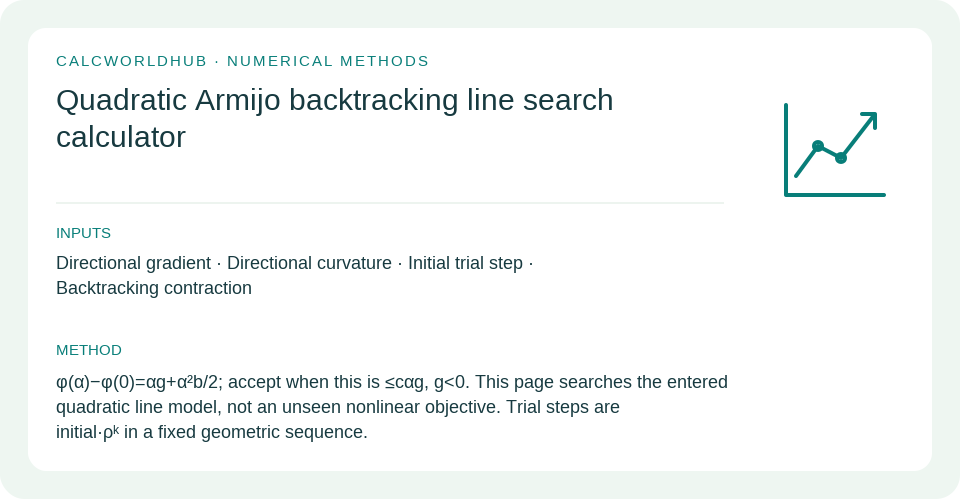
How to use this calculator
Find the first backtracked step satisfying sufficient decrease for an explicitly quadratic objective along a descent direction.
- Enter Directional gradient, Directional curvature, Initial trial step, Backtracking contraction, then complete the remaining labeled fields. Match the units shown beside each field and review the result together with the assumptions below.
- Read the worked example below to check the expected input format and result.
- Compare another scenario by changing one input at a time. Use Reset to return to the starting values.
Quadratic Armijo backtracking line search explained
This search tests positive steps against the sufficient-decrease condition for the entered quadratic line model. After a failed trial, it multiplies the step by the contraction factor and returns the first accepted value.
Inputs, symbols, and units
slope— Directional gradient- Gradient dotted with a descent direction; must be negative.
curvature— Directional curvature- Second derivative along that line for the quadratic model.
initial— Initial trial step- First positive step length.
rho— Backtracking contraction- Factor used to shrink rejected steps.
c— Armijo fraction- Required fraction of the predicted linear decrease.
Formula and method
φ(α)−φ(0)=αg+α²b/2; accept when this is ≤cαg, g<0.
This page searches the entered quadratic line model, not an unseen nonlinear objective. Trial steps are initial·ρᵏ in a fixed geometric sequence.
A worked scenario
Directional gradient = -4; Directional curvature = 10; Initial trial step = 1; Backtracking contraction = 0.5; Armijo fraction = 0.0001.
- Accepted step length: 0.5
- Quadratic objective change: -0.75 objective units
- Backtracking reductions: 1
With directional slope −4 and curvature 10, a unit step fails and a half step satisfies the default Armijo fraction.
Assumptions and edge cases
Nonnegative line curvature only. A nonlinear objective needs direct function evaluations at the trial points.
Reading the outputs
Accepted step is dimensionless when the direction already carries parameter units; change is signed objective change, with a negative value meaning decrease.
Frequently asked questions
Does Armijo return the line minimizer?
No. It returns the first tested point meeting sufficient decrease.
Why must the slope be negative?
A negative directional derivative makes the direction locally descending.
Can I use the result on a nonlinear objective directly?
Only after evaluating that objective; this calculator uses the stated quadratic model.
How do I use the Quadratic Armijo backtracking line search calculator?
Enter Directional gradient, Directional curvature, Initial trial step, Backtracking contraction, then complete the remaining labeled fields. Match the units shown beside each field and review the result together with the assumptions below.
What is a worked example of Quadratic Armijo backtracking line search?
Directional gradient = -4; Directional curvature = 10; Initial trial step = 1; Backtracking contraction = 0.5; Armijo fraction = 0.0001. Accepted step length: 0.5 Quadratic objective change: -0.75 objective units Backtracking reductions: 1 With directional slope −4 and curvature 10, a unit step fails and a half step satisfies the default Armijo fraction.
Background or definition reference: Boyd and Vandenberghe Convex Optimization.
Read our calculation methodology.