Quadratic discriminant calculator
Calculate a quadratic polynomial’s discriminant and interpret whether its roots are distinct real, repeated, or complex.
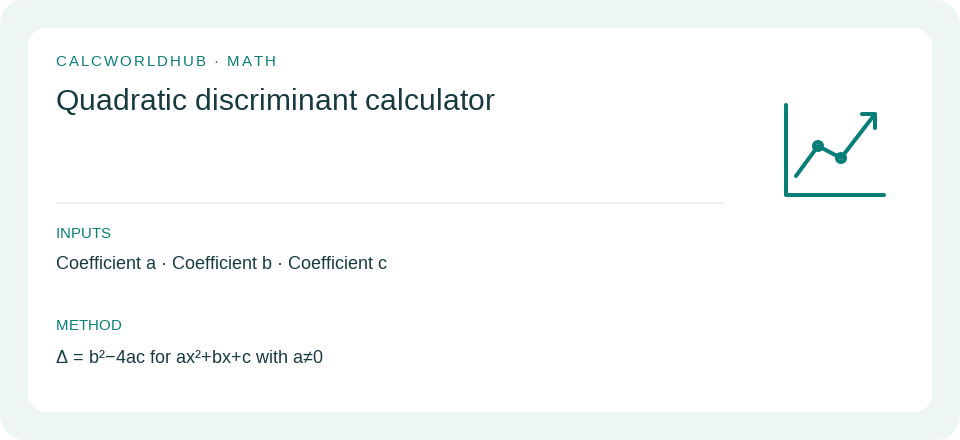
inputs.
How to use this calculator
Calculate a quadratic polynomial’s discriminant and interpret whether its roots are distinct real, repeated, or complex.
- Enter Coefficient a, Coefficient b, Coefficient c. Match the units shown beside each field and review the result together with the assumptions below.
- Read the worked example below to check the expected input format and result.
- Compare another scenario by changing one input at a time. Use Reset to return to the starting values.
How the Quadratic discriminant calculator works
Calculate a quadratic polynomial’s discriminant and interpret whether its roots are distinct real, repeated, or complex.
Inputs and units
- Coefficient a: Nonzero quadratic coefficient a.
- Coefficient b: Signed linear coefficient b.
- Coefficient c: Signed constant coefficient c.
Formula and method
Δ = b²−4ac for ax²+bx+c with a≠0
Worked example
For a=1,b=5,c=6, Δ=25−24=1, giving two distinct real roots. With a=1,b=0,c=1, Δ=−4.
Interpreting the result
Positive discriminant gives two distinct real roots; zero gives a repeated real root; negative gives a complex-conjugate pair for real coefficients.
Assumptions and limits
The leading coefficient must be nonzero for a quadratic. Coefficients can have either sign. Near zero, rounding error can affect classification for ill-scaled coefficients.
Sources and method
- Uses the discriminant in the quadratic formula and distinguishes root types. OpenStax: quadratic equations
Frequently asked questions
Is a negative discriminant invalid?
No. It indicates that the real-coefficient quadratic has no real roots.
What if a is zero?
The expression is then linear or constant, so use an equation solver appropriate to that degree.
How do I use the Quadratic discriminant calculator?
Enter Coefficient a, Coefficient b, Coefficient c. Match the units shown beside each field and review the result together with the assumptions below.
What is a worked example of Quadratic discriminant?
For a=1,b=5,c=6, Δ=25−24=1, giving two distinct real roots. With a=1,b=0,c=1, Δ=−4.
What does the Quadratic discriminant calculator calculate?
Calculate a quadratic polynomial’s discriminant and interpret whether its roots are distinct real, repeated, or complex.
See the calculation methodology.