How to use this calculator
Apply one step of the quadratic iteration g(x)=a+bx+cx² to a current estimate.
- Enter Constant term a, Linear term b, Quadratic term c, Current estimate xₙ. Match the units shown beside each field and review the result together with the assumptions below.
- Read the worked example below to check the expected input format and result.
- Compare another scenario by changing one input at a time. Use Reset to return to the starting values.
How Quadratic fixed-point iteration calculator works
Apply one step of the quadratic iteration g(x)=a+bx+cx² to a current estimate.
Inputs and units
- Constant term a: a is the constant term in the iteration map.
- Linear term b: b is the coefficient multiplying the current estimate.
- Quadratic term c: c is the coefficient multiplying its square.
- Current estimate xₙ: xₙ is the current iterate.
Formula and method
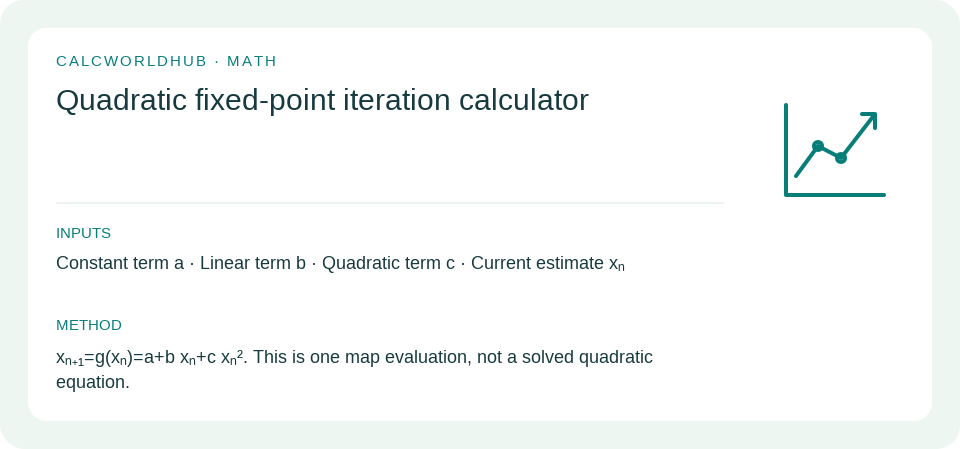
xₙ₊₁=g(xₙ)=a+b xₙ+c xₙ². This is one map evaluation, not a solved quadratic equation.
Worked example
With a=1, b=0.2, c=0, and xₙ=2, xₙ₊₁=1+0.2·2=1.4.
Interpreting the result
Repeated application may approach a fixed point x*=g(x*), but this one-step output does not certify convergence.
Assumptions and limits
Local convergence near a fixed point usually requires |g′(x*)|<1. A divergent or oscillating iteration is possible; the calculator reports the next step only.
Sources and method
- Near a fixed point, |g′(x*)|<1 is the local convergence condition for a differentiable iteration map. University of Washington: fixed-point iteration
Frequently asked questions
Is this solving ax²+bx+c=0?
No. It evaluates the specified iteration map once.
Why can a later iterate move away?
The map may not be contractive near the starting value or fixed point.
How do I use the Quadratic fixed-point iteration calculator?
Enter Constant term a, Linear term b, Quadratic term c, Current estimate xₙ. Match the units shown beside each field and review the result together with the assumptions below.
What is a worked example of Quadratic fixed-point iteration?
With a=1, b=0.2, c=0, and xₙ=2, xₙ₊₁=1+0.2·2=1.4.
What does the Quadratic fixed-point iteration calculator calculate?
Apply one step of the quadratic iteration g(x)=a+bx+cx² to a current estimate.