How to use this calculator
Find the ideal single-layer antireflection index and quarter-wave thickness at a design wavelength.
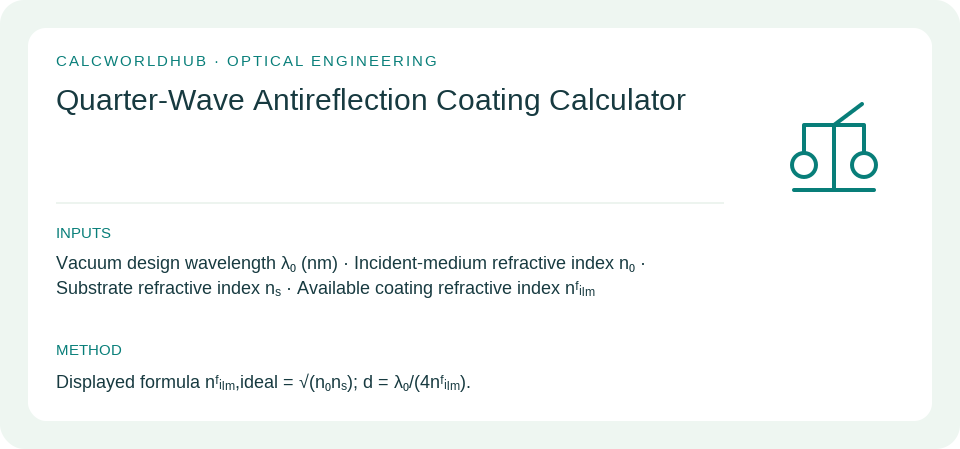
- Enter Vacuum design wavelength λ₀ (nm), Incident-medium refractive index n₀, Substrate refractive index nₛ, Available coating refractive index nᶠᵢₗₘ. Match the units shown beside each field and review the result together with the assumptions below.
- Read the worked example below to check the expected input format and result.
- Compare another scenario by changing one input at a time. Use Reset to return to the starting values.
How this calculation works
At normal incidence, a transparent single-layer coating can suppress reflection at one design wavelength when its optical thickness is one quarter wavelength and its refractive index matches the geometric mean of the incident medium and substrate.
Inputs and units
wavelength— Vacuum design wavelength λ₀ (nm)- Design wavelength in vacuum or air for the normal-incidence approximation.
incidentIndex— Incident-medium refractive index n₀- Real refractive index of the incident medium.
substrateIndex— Substrate refractive index nₛ- Real refractive index of the substrate.
filmIndex— Available coating refractive index nᶠᵢₗₘ- Real refractive index of the selected coating material.
Formula
nᶠᵢₗₘ,ideal = √(n₀nₛ); d = λ₀/(4nᶠᵢₗₘ).
Method
Calculate the ideal film index and thickness, then estimate design-wavelength reflectance for the entered real film index using the two-interface Fresnel amplitudes at quarter-wave optical thickness.
Worked example
For air on glass with nₛ = 1.52 at 550 nm, the ideal film index is 1.2329 and thickness is 111.527 nm. A quarter-wave film with n = 1.38 has estimated reflectance of 1.2601%.
Assumptions and limits
Assumes normal incidence, transparent nonabsorbing media, real refractive indices, a single uniform layer, and no dispersion across wavelength. A practical material may not have the ideal index, and a single-layer design is narrowband.
Frequently asked questions
Why is the ideal index a geometric mean?
At normal incidence, it balances the two interface reflection amplitudes so that their quarter-wave phase difference can cancel.
Does one layer eliminate reflection at every wavelength?
No. The phase condition is tuned to the design wavelength, so a single layer is narrowband.
Does this include angled rays or absorbing films?
No. The estimate assumes normal incidence, real nonabsorbing indices, and one uniform layer.
How do I use the Quarter-Wave Antireflection Coating Calculator?
Enter Vacuum design wavelength λ₀ (nm), Incident-medium refractive index n₀, Substrate refractive index nₛ, Available coating refractive index nᶠᵢₗₘ. Match the units shown beside each field and review the result together with the assumptions below.
What is a worked example of Quarter-Wave Antireflection Coating?
For air on glass with nₛ = 1.52 at 550 nm, the ideal film index is 1.2329 and thickness is 111.527 nm. A quarter-wave film with n = 1.38 has estimated reflectance of 1.2601%.
Reference: Peer-reviewed single-layer antireflection coating index and thickness relation. See our calculation methodology.