How to use this calculator
Estimate short-term liquidity using cash, marketable securities, and receivables relative to current liabilities.
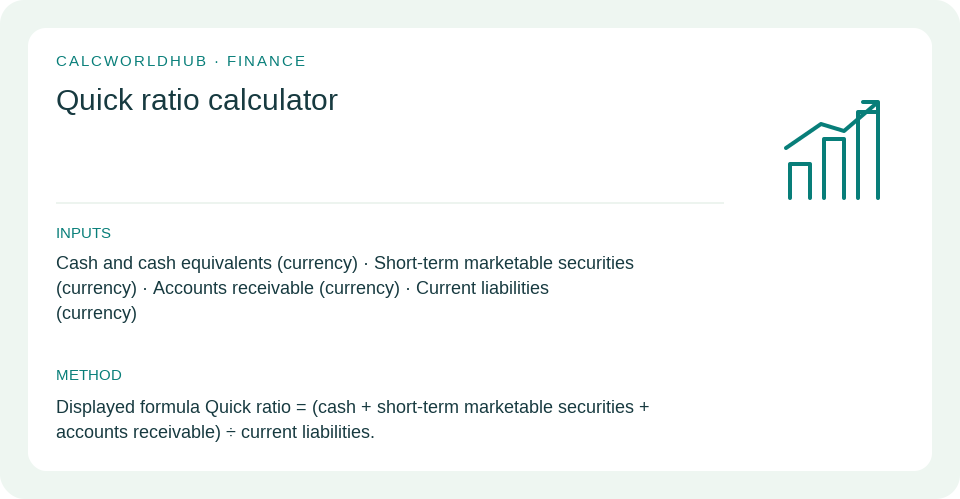
- Enter Cash and cash equivalents (currency), Short-term marketable securities (currency), Accounts receivable (currency), Current liabilities (currency). Match the units shown beside each field and review the result together with the assumptions below.
- Read the worked example below to check the expected input format and result.
- Compare another scenario by changing one input at a time. Use Reset to return to the starting values.
How this calculation works
The quick ratio focuses on current assets that are generally more readily available than inventory. This version explicitly totals cash, short-term marketable securities, and receivables so the included asset definition is visible.
Inputs and units
cash— Cash and cash equivalents (currency)- Use unrestricted cash and cash equivalents from the balance sheet.
securities— Short-term marketable securities (currency)- Include only securities treated as current and readily marketable.
receivables— Accounts receivable (currency)- Use the receivables amount appropriate to your chosen reporting convention.
liabilities— Current liabilities (currency)- Use current liabilities for the same reporting date.
Formula
Quick ratio = (cash + short-term marketable securities + accounts receivable) ÷ current liabilities.
Method
Add the three entered quick-asset balances, then divide by current liabilities from the same reporting date. Inventory, prepaid expenses, and other excluded balances are not added.
Worked example
Cash of $80,000, securities of $20,000, and receivables of $50,000 total $150,000. With $100,000 of current liabilities, the quick ratio is 1.5×.
Assumptions and limits
Definitions can differ: some published versions begin with current assets and subtract inventory and prepayments. Receivable collectability, restricted cash, and marketability can change the practical meaning of the result.
Frequently asked questions
Does the quick ratio include inventory?
No. The inputs here are cash, short-term marketable securities, and accounts receivable; inventory is excluded.
Why is the quick ratio below the current ratio?
When current assets include inventory or prepayments, excluding those balances can reduce quick assets. The exact comparison depends on the values entered and definitions used.
Should doubtful receivables be included?
Use a receivables balance consistent with the financial statement or analysis convention, and account for allowances or doubtful amounts as appropriate.
How do I use the Quick ratio calculator?
Enter Cash and cash equivalents (currency), Short-term marketable securities (currency), Accounts receivable (currency), Current liabilities (currency). Match the units shown beside each field and review the result together with the assumptions below.
What is a worked example of Quick ratio?
Cash of $80,000, securities of $20,000, and receivables of $50,000 total $150,000. With $100,000 of current liabilities, the quick ratio is 1.5×.
Read our calculation methodology.