How to use this calculator
Check a terrain obstacle against a chosen Fresnel clearance fraction while including effective Earth curvature.
- Enter Distance from first terminal (m), Distance from second terminal (m), Radio frequency (Hz), Obstacle clearance below straight line (m), then complete the remaining labeled fields. Match the units shown beside each field and review the result together with the assumptions below.
- Read the worked example below to check the expected input format and result.
- Compare another scenario by changing one input at a time. Use Reset to return to the starting values.
Radio-path Fresnel and Earth-bulge clearance explained
Check a terrain obstacle against a chosen Fresnel clearance fraction while including effective Earth curvature.
How the calculation works
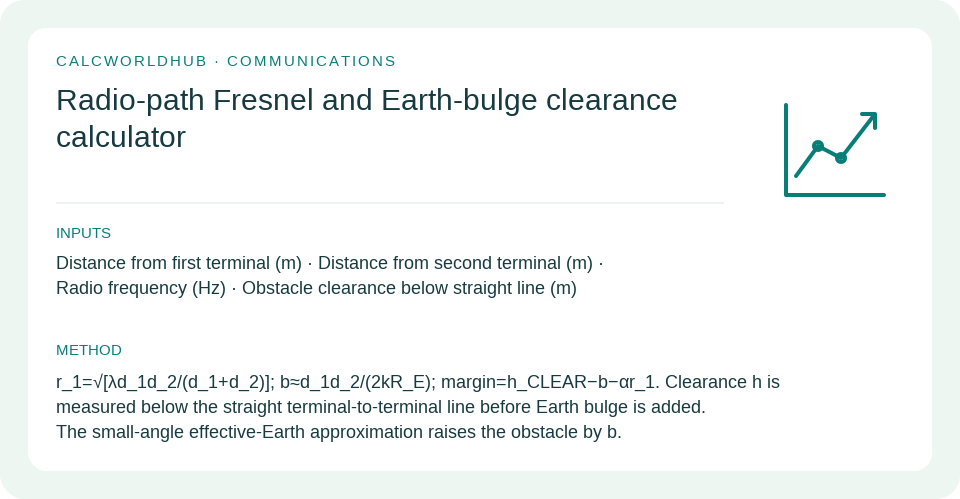
r_1=√[λd_1d_2/(d_1+d_2)]; b≈d_1d_2/(2kR_E); margin=h_CLEAR−b−αr_1.
Clearance h is measured below the straight terminal-to-terminal line before Earth bulge is added. The small-angle effective-Earth approximation raises the obstacle by b.
Set up the calculation
d1— Distance from first terminal (m)- Horizontal distance to the obstacle.
d2— Distance from second terminal (m)- Horizontal distance from obstacle to other terminal.
f— Radio frequency (Hz)- Frequency determining Fresnel radius.
h— Obstacle clearance below straight line (m)- Positive when obstacle top is below the uncurved direct line; negative means obstruction.
k— Effective Earth-radius factor- Atmospheric refraction represented as an effective Earth radius multiplier.
fraction— Required Fresnel radius fraction- Chosen clearance criterion; no universal reliability is implied.
Limits of this model
Single obstacle, small-angle spherical-Earth approximation and a supplied refraction factor; no terrain-profile or climate probability model.
Check this example
Distance from first terminal (m) = 5000; Distance from second terminal (m) = 7000; Radio frequency (Hz) = 6000000000; Obstacle clearance below straight line (m) = 12; Effective Earth-radius factor = 1.333333; Required Fresnel radius fraction = 0.6.
- Clearance margin: 2.696702 m
- First Fresnel radius: 12.071969 m
- Effective Earth bulge: 2.060116 m
A 6 GHz, 12 km path has an obstacle 5 km from one end and 12 m below the straight line; test 60% Fresnel clearance with a 4/3 effective Earth radius.
Reading the outputs
A negative margin means the selected clearance criterion is unmet. It is not itself a predicted outage or diffraction loss.
Frequently asked questions
Is sixty-percent clearance a reliability guarantee?
No; it is a geometric criterion, not an availability prediction.
Why can a visible path fail this check?
A clear optical ray can still intrude into the larger Fresnel zone.
What if my heights already include Earth curvature?
Do not add bulge twice; use a straight-line pre-bulge clearance for this convention.
How do I use the Radio-path Fresnel and Earth-bulge clearance calculator?
Enter Distance from first terminal (m), Distance from second terminal (m), Radio frequency (Hz), Obstacle clearance below straight line (m), then complete the remaining labeled fields. Match the units shown beside each field and review the result together with the assumptions below.
What is a worked example of Radio-path Fresnel and Earth-bulge clearance?
Distance from first terminal (m) = 5000; Distance from second terminal (m) = 7000; Radio frequency (Hz) = 6000000000; Obstacle clearance below straight line (m) = 12; Effective Earth-radius factor = 1.333333; Required Fresnel radius fraction = 0.6. Clearance margin: 2.696702 m First Fresnel radius: 12.071969 m Effective Earth bulge: 2.060116 m A 6 GHz, 12 km path has an obstacle 5 km from one end and 12 m below the straight line; test 60% Fresnel clearance with a 4/3 effective Earth radius.
Background or definition reference: ITU-R P.526-16 diffraction propagation.
Read our calculation methodology.