How to use this calculator
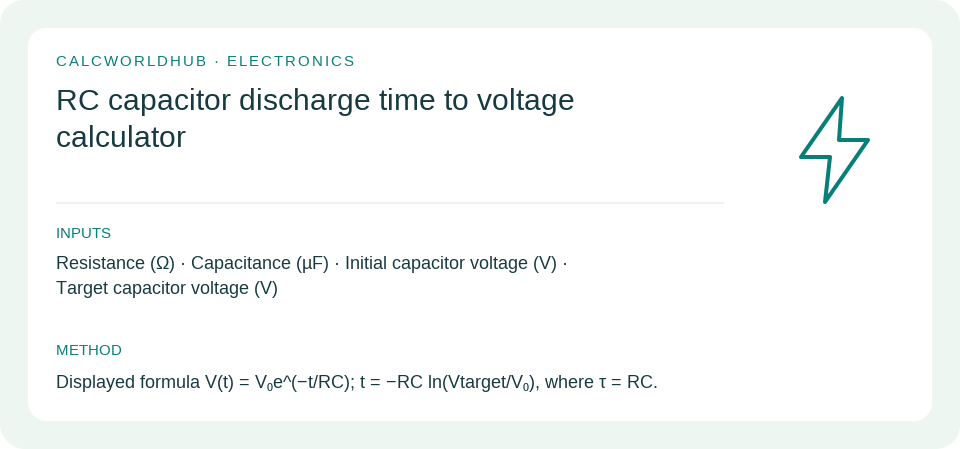
Find how long an ideal resistor-capacitor circuit takes to decay from an initial voltage to a target voltage.
- Enter Resistance (Ω), Capacitance (µF), Initial capacitor voltage (V), Target capacitor voltage (V). Match the units shown beside each field and review the result together with the assumptions below.
- Read the worked example below to check the expected input format and result.
- Compare another scenario by changing one input at a time. Use Reset to return to the starting values.
How this calculation works
This calculator solves the first-order RC discharge equation for time instead of reporting only the time constant. Enter resistance, capacitance, and the starting and target capacitor voltages.
Inputs and units
resistance— Resistance (Ω)- Equivalent discharge resistance.
capacitance— Capacitance (µF)- Capacitance in microfarads.
initial— Initial capacitor voltage (V)- Voltage at the start of discharge.
target— Target capacitor voltage (V)- Positive voltage at which to find elapsed time.
Formula
V(t) = V₀e^(−t/RC); t = −RC ln(Vtarget/V₀), where τ = RC.
Worked example
For R = 10 kΩ, C = 100 µF, and a drop from 5 V to 1 V, τ = 1 s and t = −1 × ln(1/5) ≈ 1.609 s.
Assumptions and limits
Assumes an ideal capacitor discharging through a constant resistance with no source, leakage, load variation, or switching transient. Reaching exactly zero volts takes infinite time in this model.
Frequently asked questions
What happens at one time constant?
After one time constant, an ideal discharge retains e⁻¹, about 36.8%, of its initial voltage.
Can the target be zero volts?
No finite time reaches exactly zero in the ideal exponential model, so use a positive threshold.
Does the resistor value stay constant?
The model assumes it does; nonlinear loads and capacitor leakage can change the real discharge curve.
How do I use the RC capacitor discharge time to voltage calculator?
Enter Resistance (Ω), Capacitance (µF), Initial capacitor voltage (V), Target capacitor voltage (V). Match the units shown beside each field and review the result together with the assumptions below.
What is a worked example of RC capacitor discharge time to voltage?
For R = 10 kΩ, C = 100 µF, and a drop from 5 V to 1 V, τ = 1 s and t = −1 × ln(1/5) ≈ 1.609 s.
Read our calculation methodology.