How to use this calculator
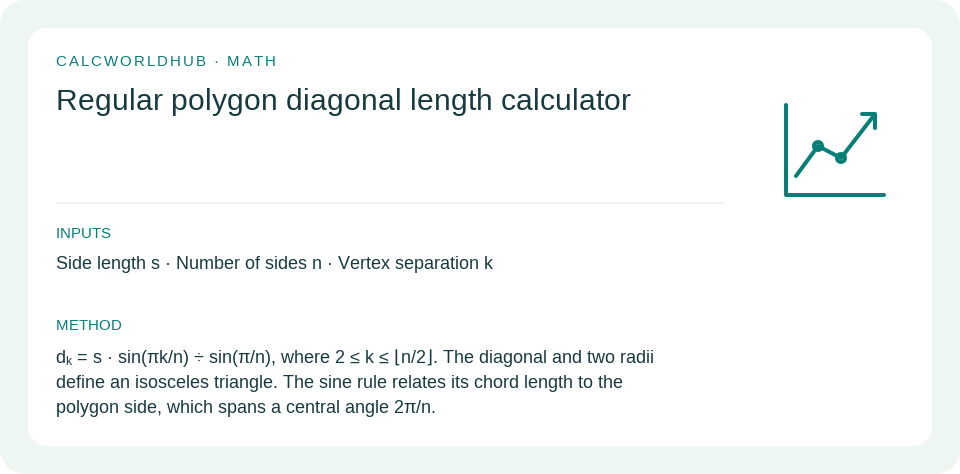
Calculate a regular polygon’s diagonal length from its side length, number of sides, and vertex separation.
- Enter Side length s, Number of sides n, Vertex separation k. Match the units shown beside each field and review the result together with the assumptions below.
- Read the worked example below to check the expected input format and result.
- Compare another scenario by changing one input at a time. Use Reset to return to the starting values.
How this calculation works
The vertex step determines which two vertices are joined; for a fixed side length, changing the number of sides changes the corresponding chord length.
Inputs and meanings
side— Side length s- Enter a positive side length.
sides— Number of sides n- Enter an integer of at least 3.
step— Vertex separation k- Use an integer from 2 through floor(n/2).
Formula and method
dₖ = s · sin(πk/n) ÷ sin(π/n), where 2 ≤ k ≤ ⌊n/2⌋.
The diagonal and two radii define an isosceles triangle. The sine rule relates its chord length to the polygon side, which spans a central angle 2π/n.
Worked example
For an octagon with side 5 and separation k=2, d=5·sin(45°)/sin(22.5°) ≈ 9.239 units.
Assumptions and limits
The polygon must be regular and have at least three sides. The separation k counts edges along the shorter route between the selected vertices.
Frequently asked questions
What does vertex separation mean?
It is the number of polygon edges along the shorter path between the two diagonal endpoints.
Can k equal 1?
That would describe one polygon side, not a diagonal; use k ≥ 2.
Why is the polygon required to be regular?
Equal sides and equal central angles make the chord formula depend only on side length, side count, and separation.
How do I use the Regular polygon diagonal length calculator?
Enter Side length s, Number of sides n, Vertex separation k. Match the units shown beside each field and review the result together with the assumptions below.
What is a worked example of Regular polygon diagonal length?
For an octagon with side 5 and separation k=2, d=5·sin(45°)/sin(22.5°) ≈ 9.239 units.
Read our calculation methodology.