How to use this calculator
Estimate the relative feed value of a forage sample from dry-matter ADF and NDF results.
- Enter Acid detergent fiber, ADF (% of dry matter), Neutral detergent fiber, NDF (% of dry matter). Match the units shown beside each field and review the result together with the assumptions below.
- Read the worked example below to check the expected input format and result.
- Compare another scenario by changing one input at a time. Use Reset to return to the starting values.
How this calculation works
Enter acid detergent fiber (ADF) and neutral detergent fiber (NDF) as percentages of dry matter from a forage analysis. The calculator estimates digestible dry matter (DDM) and dry matter intake (DMI), then combines them into the traditional Relative Feed Value (RFV) index.
Inputs and units
adf— Acid detergent fiber, ADF (% of dry matter)- Enter laboratory ADF as a percentage of dry matter.
ndf— Neutral detergent fiber, NDF (% of dry matter)- Enter laboratory NDF as a percentage of dry matter; NDF must be positive and at least as large as ADF.
Formula
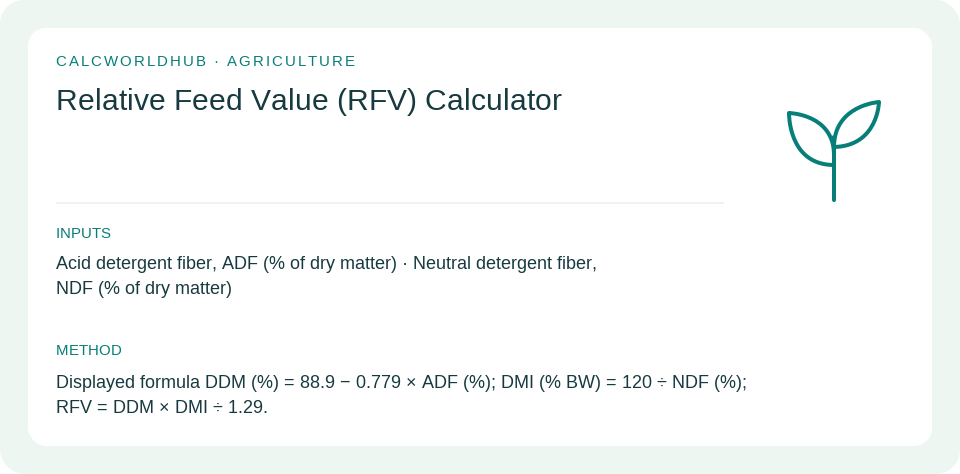
DDM (%) = 88.9 − 0.779 × ADF (%); DMI (% BW) = 120 ÷ NDF (%); RFV = DDM × DMI ÷ 1.29.
Method
Estimate DDM from ADF and intake potential from NDF using the conventional RFV equations. Divide their product by 1.29 to normalize the index so full-bloom alfalfa is near 100.
Worked example
For ADF = 28% and NDF = 38% of dry matter, estimated DDM is 67.09%, estimated DMI is 3.158% of body weight, and RFV is 164.23.
Assumptions and limits
RFV is a relative forage index, not a direct nutrient concentration or ration-balancing result. It is most appropriate for comparing hays under the traditional calibration assumptions; those assumptions may not fit grasses and other forage types. Use a forage-specific RFQ or a complete feed analysis for ration formulation.
Frequently asked questions
What does RFV combine?
RFV combines an ADF-based estimate of digestible dry matter with an NDF-based estimate of dry matter intake potential.
What basis should I use for ADF and NDF?
Use the forage laboratory values expressed as percentages of dry matter.
Can RFV be used to balance a ration?
No. RFV is a relative index used primarily to compare hay. Use the full forage analysis and animal requirements for ration formulation.
How do I use the Relative Feed Value (RFV) Calculator?
Enter Acid detergent fiber, ADF (% of dry matter), Neutral detergent fiber, NDF (% of dry matter). Match the units shown beside each field and review the result together with the assumptions below.
What is a worked example of Relative Feed Value (RFV)?
For ADF = 28% and NDF = 38% of dry matter, estimated DDM is 67.09%, estimated DMI is 3.158% of body weight, and RFV is 164.23.
Reference: Oklahoma State Extension stocking-rate guidance. See our calculation methodology.