How to use this calculator
Estimate the leading general-relativistic periapsis advance per orbit about a nonrotating central mass.
- Enter Central gravitational parameter (km³/s²), Semi-major axis (million km), Orbital eccentricity. Match the units shown beside each field and review the result together with the assumptions below.
- Read the worked example below to check the expected input format and result.
- Compare another scenario by changing one input at a time. Use Reset to return to the starting values.
Relativistic periapsis advance explained
Estimate the leading Schwarzschild contribution to periapsis advance per orbit from a central mass parameter and Keplerian ellipse. This is one component of precession, not the measured total.
How the calculation works
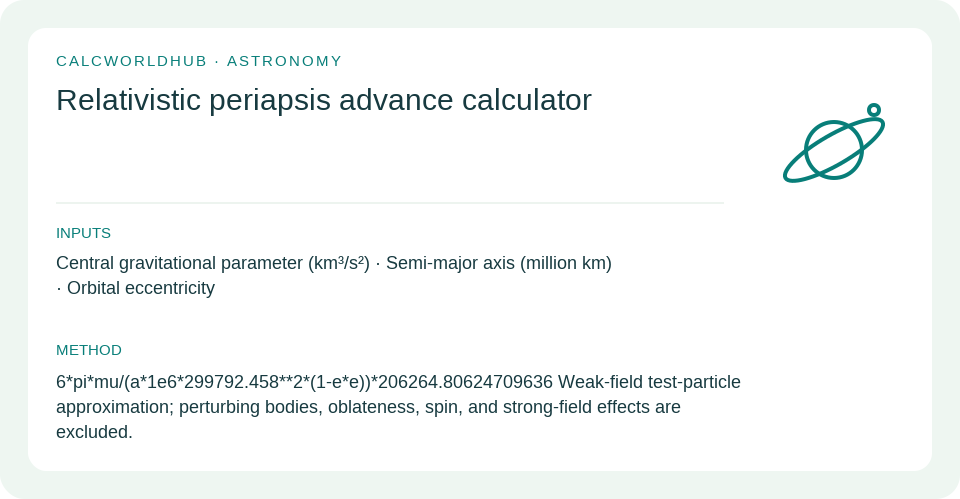
6*pi*mu/(a*1e6*299792.458**2*(1-e*e))*206264.80624709636
Weak-field test-particle approximation; perturbing bodies, oblateness, spin, and strong-field effects are excluded.
Set up the calculation
mu— Central gravitational parameter (km³/s²)- The central body’s gravitational parameter GM, in km³/s².
a— Semi-major axis (million km)- The Keplerian semi-major axis in millions of kilometres; the formula converts it to km.
e— Orbital eccentricity- Dimensionless orbital eccentricity; 0 is circular and values must remain below 1 for an ellipse.
Limits of this model
Weak-field test-particle approximation; perturbing bodies, oblateness, spin, and strong-field effects are excluded.
Check this example
Central gravitational parameter (km³/s²) = 132712440018; Semi-major axis (million km) = 57.90905; Orbital eccentricity = 0.20563.
- Relativistic periapsis advance: 0.103517 arcsec/orbit
Interpreting the result
The result is an angular shift for one orbit in arcseconds. To compare with a per-century observation, multiply by the number of completed orbits per century and add the other modeled precession sources separately.
Frequently asked questions
Is this total measured precession?
No, other contributions can be substantial.
Why per orbit?
A time-based rate also needs the orbital period.
Does it apply to a circular orbit?
The formal expression exists, but a circular orbit has no unique periapsis direction.
How do I use the Relativistic periapsis advance calculator?
Enter Central gravitational parameter (km³/s²), Semi-major axis (million km), Orbital eccentricity. Match the units shown beside each field and review the result together with the assumptions below.
What is a worked example of Relativistic periapsis advance?
Central gravitational parameter (km³/s²) = 132712440018; Semi-major axis (million km) = 57.90905; Orbital eccentricity = 0.20563. Relativistic periapsis advance: 0.103517 arcsec/orbit
Formula reference: Periastron advance in neutron star–black hole binaries, Monthly Notices of the Royal Astronomical Society. This is the leading weak-field test-particle term.