How to use this calculator
Combine food and labor costs to calculate restaurant prime cost and its share of net sales.
- Enter Food and beverage cost ($), Labor cost ($), Net sales for the same period ($). Match the units shown beside each field and review the result together with the assumptions below.
- Read the worked example below to check the expected input format and result.
- Compare another scenario by changing one input at a time. Use Reset to return to the starting values.
How this calculation works
Prime cost brings two direct operating cost groups into one period-level view: food and beverage purchases used, plus labor expenses. Tracking the dollar total alongside the sales percentage makes it easier to compare periods when revenue changes.
Inputs and units
foodCost— Food and beverage cost ($)- Cost of food and beverages used during the selected period, using your consistent accounting basis.
laborCost— Labor cost ($)- Include the wage, payroll tax, benefit, or other labor components your operation tracks as prime cost.
netSales— Net sales for the same period ($)- Use sales after the same discounts and tax treatment used in your restaurant reports.
Formula
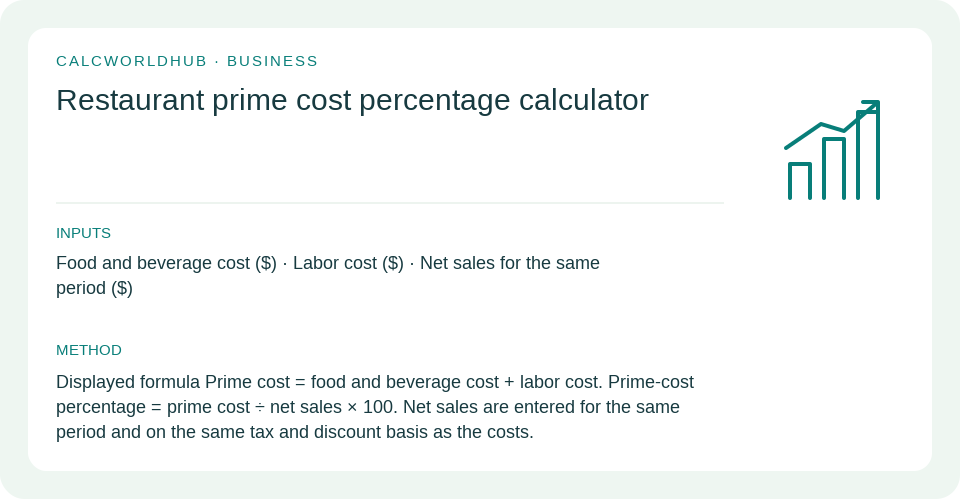
Prime cost = food and beverage cost + labor cost. Prime-cost percentage = prime cost ÷ net sales × 100. Net sales are entered for the same period and on the same tax and discount basis as the costs.
Method
Enter food and beverage cost, labor cost, and net sales for one matching accounting period. Include the labor components your operation uses consistently, then compare periods only when the cost definitions and sales basis match.
Worked example
For $28,500 food and beverage cost, $31,200 labor cost, and $90,000 net sales, prime cost is $59,700. The percentage is $59,700 ÷ $90,000 × 100 = 66.33%.
Assumptions and limits
This is an arithmetic operating ratio, not a profitability forecast. It excludes rent, utilities, fees, debt service, taxes, and other expenses unless they are explicitly included in one of the entered categories. There is no universal target that fits every restaurant format or accounting method.
Frequently asked questions
What costs belong in restaurant prime cost?
The common restaurant measure combines food and beverage cost with labor cost. Decide which payroll components to include and apply that definition consistently across periods.
Should sales include sales tax?
Use the net-sales basis in your accounting reports, and keep it consistent with the cost period. Tax treatment can differ across reporting systems.
Does a lower percentage always mean better performance?
Not by itself. Menu mix, service model, accounting definitions, and the level of other expenses also matter; compare like periods and business formats.
How do I use the Restaurant prime cost percentage calculator?
Enter Food and beverage cost ($), Labor cost ($), Net sales for the same period ($). Match the units shown beside each field and review the result together with the assumptions below.
What is a worked example of Restaurant prime cost percentage?
For $28,500 food and beverage cost, $31,200 labor cost, and $90,000 net sales, prime cost is $59,700. The percentage is $59,700 ÷ $90,000 × 100 = 66.33%.
Reference: National Restaurant Association operating-cost research. See our calculation methodology.