How to use this calculator
Plan the retail value of new inventory purchases after sales, markdowns, stock targets, and commitments.
- Enter Planned sales, Planned markdowns, Target ending inventory, Beginning inventory, then complete the remaining labeled fields. Match the units shown beside each field and review the result together with the assumptions below.
- Read the worked example below to check the expected input format and result.
- Compare another scenario by changing one input at a time. Use Reset to return to the starting values.
How this calculation works
Open-to-buy (OTB) translates a retail inventory plan into purchasing room for a period. Start with forecast sales, markdowns, and desired ending stock; subtract beginning stock and inventory already committed on purchase orders that will arrive in the period.
Inputs and units
sales— Planned sales- Forecast sales for the planning period, at retail value.
markdowns— Planned markdowns- Forecast reductions from planned retail value during the same period.
endingInventory— Target ending inventory- Desired inventory value at the end of the period, at retail.
beginningInventory— Beginning inventory- Planned inventory value at the start of the period, at retail.
onOrder— Purchase orders due in period- Retail value of inventory already committed and expected to arrive during this planning period.
Formula
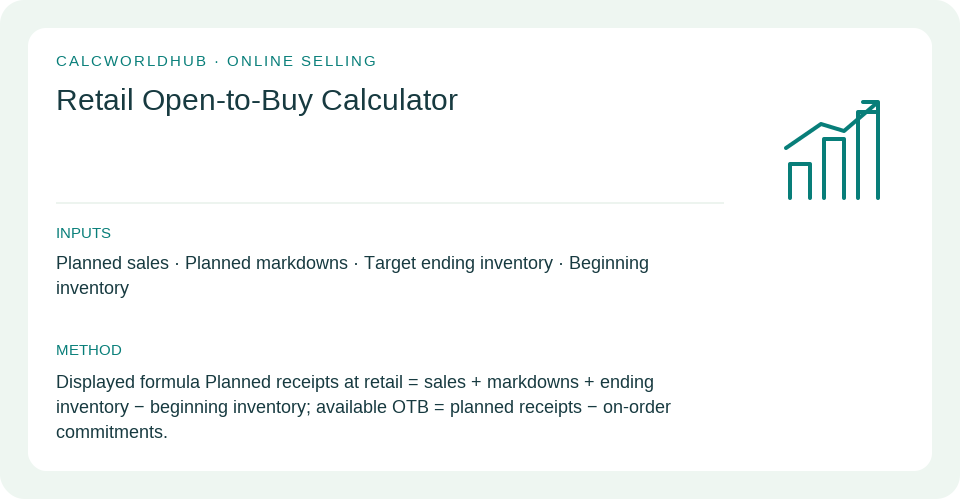
Planned receipts at retail = sales + markdowns + ending inventory − beginning inventory; available OTB = planned receipts − on-order commitments.
Method
All five inputs are retail selling-price values for the same period. The first result is planned receipts needed to meet the sales and ending-stock plan; the second deducts inventory already on order to show remaining buying room.
Worked example
With $42,000 planned sales, $4,000 markdowns, $18,000 target ending stock, $25,000 beginning stock, and $6,000 on order, planned receipts are $39,000 and remaining OTB is $33,000 at retail.
Assumptions and limits
Use a consistent retail valuation basis and match purchase orders to the same period. This is a planning estimate, not a supplier cash budget; cost-based OTB, cancellations, returns, and purchase timing require separate adjustments.
Frequently asked questions
What does a negative open-to-buy mean?
The plan's existing stock and purchase commitments exceed the receipts needed to hit the sales and ending-inventory targets.
Should I enter values at retail or cost?
This calculator uses retail value for every input. Do not mix retail selling prices with merchandise cost.
Does the calculation include purchase orders already placed?
Yes. Enter orders expected in the period; the tool subtracts their retail value from planned receipts.
Can I use OTB for a weekly plan?
Yes, as long as sales, markdowns, inventory, and orders all refer to that same week and valuation basis.
How do I use the Retail Open-to-Buy Calculator?
Enter Planned sales, Planned markdowns, Target ending inventory, Beginning inventory, then complete the remaining labeled fields. Match the units shown beside each field and review the result together with the assumptions below.
Reference: Shopify retail open-to-buy planning formula and definitions. See our calculation methodology.