RL step current response calculator
Calculate current after a DC voltage step in an ideal series RL circuit initially carrying zero current.
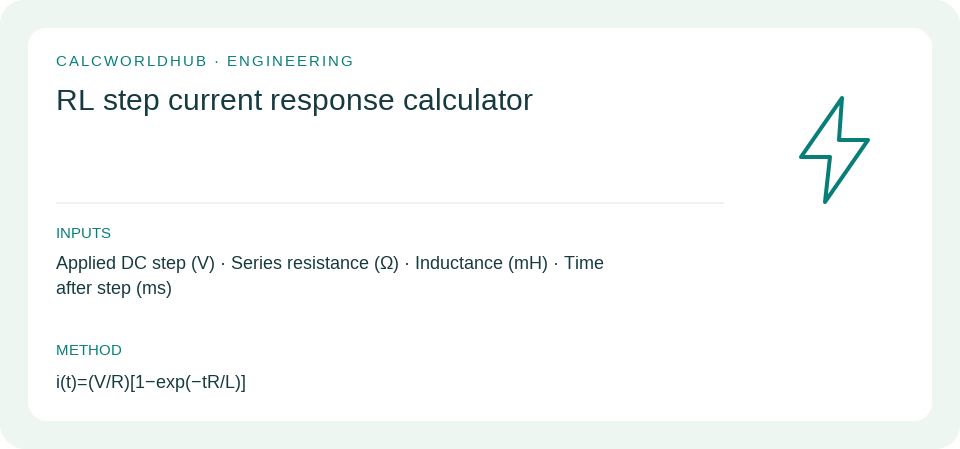
How to use this calculator
Calculate current after a DC voltage step in an ideal series RL circuit initially carrying zero current.
- Enter Applied DC step (V), Series resistance (Ω), Inductance (mH), Time after step (ms). Match the units shown beside each field and review the result together with the assumptions below.
- Read the worked example below to check the expected input format and result.
- Compare another scenario by changing one input at a time. Use Reset to return to the starting values.
How the RL step current response calculator works
Calculate current after a DC voltage step in an ideal series RL circuit initially carrying zero current.
Inputs and units
- Applied DC step (V): Signed applied DC step voltage.
- Series resistance (Ω): Positive total series resistance in Ω.
- Inductance (mH): Positive inductance in mH.
- Time after step (ms): Nonnegative elapsed time in ms after the step.
Formula and method
i(t)=(V/R)[1−exp(−tR/L)]
Worked example
With V=12 V, R=20 Ω, L=100 mH, and t=5 ms, τ=L/R=5 ms and current=0.6(1−e^−1)=0.379272 A.
Interpreting the result
Current approaches the final value V/R exponentially. After one time constant it has reached about 63.2% of that final value.
Assumptions and limits
Assumes zero initial current, constant R and L, no saturation, and an ideal voltage step. Signed voltage is allowed; time is nonnegative.
Sources and method
- Derives exponential current buildup in an ideal RL circuit. OpenStax: RL circuits
Frequently asked questions
What if the inductor already carries current?
This formula does not include a nonzero initial-current term; use the general RL transient solution.
What does zero elapsed time give?
Zero current, matching the stated initial condition.
How do I use the RL step current response calculator?
Enter Applied DC step (V), Series resistance (Ω), Inductance (mH), Time after step (ms). Match the units shown beside each field and review the result together with the assumptions below.
What is a worked example of RL step current response?
With V=12 V, R=20 Ω, L=100 mH, and t=5 ms, τ=L/R=5 ms and current=0.6(1−e^−1)=0.379272 A.
What does the RL step current response calculator calculate?
Calculate current after a DC voltage step in an ideal series RL circuit initially carrying zero current.
See the calculation methodology.