How to use this calculator
Compare nonnegative actuals and forecasts on a log scale, emphasizing proportional differences while reducing the influence of large magnitudes.
- Enter Observed nonnegative values, Predicted nonnegative values. Match the units shown beside each field and review the result together with the assumptions below.
- Read the worked example below to check the expected input format and result.
- Compare another scenario by changing one input at a time. Use Reset to return to the starting values.
How Root mean squared logarithmic error calculator works
Compare nonnegative actuals and forecasts on a log scale, emphasizing proportional differences while reducing the influence of large magnitudes.
Inputs and units
- Observed nonnegative values: Comma-separated nonnegative actual values A, paired in order with forecasts.
- Predicted nonnegative values: Comma-separated nonnegative forecasts F with the same list length as actuals.
Formula and method
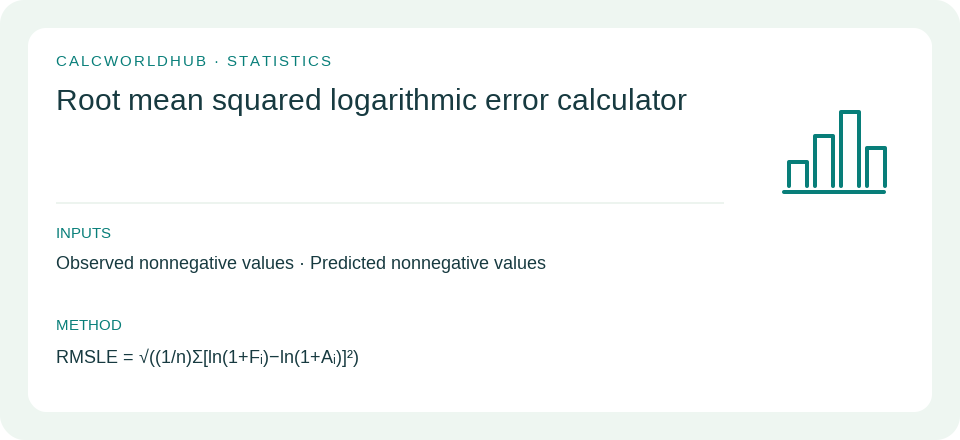
RMSLE = √((1/n)Σ[ln(1+Fᵢ)−ln(1+Aᵢ)]²)
Worked example
For actuals (10,100,1000) and forecasts (12,90,1100), average the three squared ln(1+value) differences and take the square root: RMSLE≈0.1263.
Interpreting the result
The result is nonnegative and has no original measurement unit. Zero means exact matches; a fixed relative error tends to matter more than the same absolute error at a large scale.
Assumptions and limits
Actuals and forecasts must be paired, equal length, and nonnegative because ln(1+x) is used. The +1 offset depends on the chosen unit and should be interpreted consistently across datasets.
Sources and method
- RMSLE loss definition and implementation reference for paired regression targets. scikit-learn, root_mean_squared_log_error
Frequently asked questions
Why add 1 before taking logs?
It allows zero values while keeping the logarithm defined for all nonnegative inputs.
Does RMSLE have the same units as the data?
No. Log differences are dimensionless, but the +1 convention means the input scale still matters.
How do I use the Root mean squared logarithmic error calculator?
Enter Observed nonnegative values, Predicted nonnegative values. Match the units shown beside each field and review the result together with the assumptions below.
What is a worked example of Root mean squared logarithmic error?
For actuals (10,100,1000) and forecasts (12,90,1100), average the three squared ln(1+value) differences and take the square root: RMSLE≈0.1263.
What does the Root mean squared logarithmic error calculator calculate?
Compare nonnegative actuals and forecasts on a log scale, emphasizing proportional differences while reducing the influence of large magnitudes.