How to use this calculator
Compare projected after-tax account values for Roth and traditional contributions with the same current take-home cost.
- Enter Annual take-home contribution budget ($), Current marginal tax rate (%), Future marginal tax rate on traditional withdrawal (%), Annual investment return (%), then complete the remaining labeled fields. Match the units shown beside each field and review the result together with the assumptions below.
- Read the worked example below to check the expected input format and result.
- Compare another scenario by changing one input at a time. Use Reset to return to the starting values.
How this calculation works
Roth and traditional accounts apply tax at different stages. This comparison holds the current after-tax cash budget constant: a Roth contribution uses that budget directly, while a traditional contribution is grossed up by the entered current marginal tax rate under the assumption that the contribution is fully deductible. It then applies a future tax rate to the traditional balance only.
Inputs and units
annualBudget— Annual take-home contribution budget ($)- Amount of current after-tax cash you are willing to give up each year.
currentTaxPct— Current marginal tax rate (%)- Used to gross up the traditional contribution under the full-deductibility assumption.
futureTaxPct— Future marginal tax rate on traditional withdrawal (%)- Applied to the modeled traditional balance; qualified Roth balance is treated as tax-free.
annualReturnPct— Annual investment return (%)- Same effective annual return is applied to both accounts.
years— Years invested- Whole-year period; contributions occur at each year end.
Formula
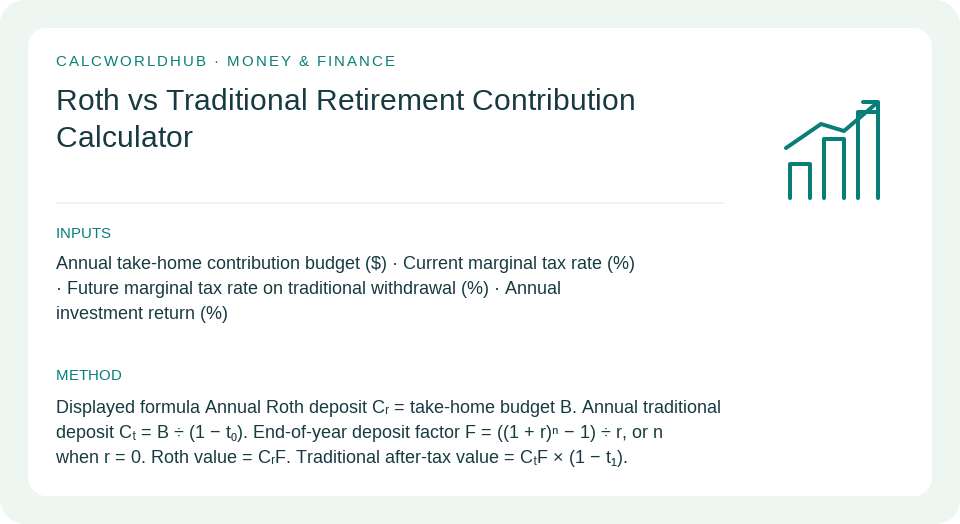
Annual Roth deposit Cᵣ = take-home budget B. Annual traditional deposit Cₜ = B ÷ (1 − t₀). End-of-year deposit factor F = ((1 + r)ⁿ − 1) ÷ r, or n when r = 0. Roth value = CᵣF. Traditional after-tax value = CₜF × (1 − t₁).
Method
Enter the annual take-home cash cost, current and future marginal tax rates as percentages, annual investment return, and years invested. Deposits are assumed to occur at each year end. The comparison shows how the tax-rate assumptions affect balances when the current spending cost is held equal.
Worked example
With a $6,000 annual take-home budget, a 22% current rate, an 18% future rate, a 6% return, and 20 year-end contributions, the Roth projection is $220,713.55. The traditional contribution is $6,000 ÷ 0.78 = $7,692.31 per year; its projected pre-tax balance is taxed at 18%, leaving $232,032.19, or $11,318.64 more under these assumptions.
Assumptions and limits
This simplified illustration assumes full deductibility at the current tax rate, qualified Roth withdrawals, equal investment return, and no employer match, fees, contribution limits, income eligibility limits, tax credits, state-tax differences, or inflation. Actual tax treatment depends on account type and circumstances; this is not tax or investment advice.
Frequently asked questions
Why is the traditional contribution larger in this comparison?
The model compares equal current take-home cost. It assumes the traditional contribution reduces current taxable income at the entered rate, so the same cash budget supports a larger pre-tax deposit.
What happens if the current and future tax rates are equal?
With equal rates and the same return, timing, and cash-cost assumptions, the modeled after-tax balances are equal before fees and limits.
Does the calculator account for contribution limits?
No. It may show a grossed-up traditional amount above a legal or plan limit; verify current rules and plan terms separately.
Are Roth withdrawals always tax-free?
No. The model assumes a qualified withdrawal. Eligibility and distribution rules depend on account type and circumstances.
How do I use the Roth vs Traditional Retirement Contribution Calculator?
Enter Annual take-home contribution budget ($), Current marginal tax rate (%), Future marginal tax rate on traditional withdrawal (%), Annual investment return (%), then complete the remaining labeled fields. Match the units shown beside each field and review the result together with the assumptions below.
Reference: IRS overview of traditional and Roth IRA contribution and distribution tax treatment. See our calculation methodology.