How to use this calculator
Compare uncompensated lead resistance with the mismatch remaining in an ideal compensated three-wire RTD measurement.
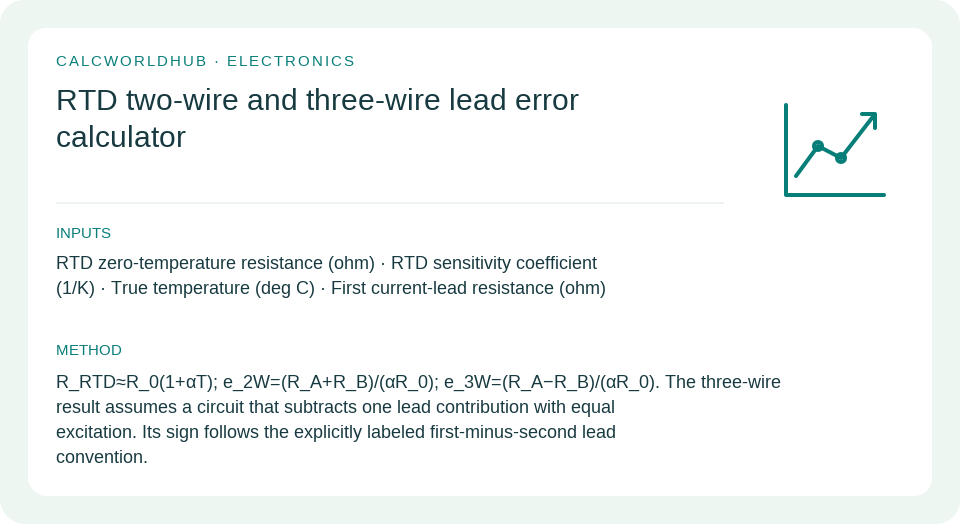
- Enter RTD zero-temperature resistance (ohm), RTD sensitivity coefficient (1/K), True temperature (deg C), First current-lead resistance (ohm), then complete the remaining labeled fields. Match the units shown beside each field and review the result together with the assumptions below.
- Read the worked example below to check the expected input format and result.
- Compare another scenario by changing one input at a time. Use Reset to return to the starting values.
RTD two-wire and three-wire lead error explained
A numerical walkthrough
RTD zero-temperature resistance (ohm) = 100; RTD sensitivity coefficient (1/K) = 0.00385; True temperature (deg C) = 50; First current-lead resistance (ohm) = 1; Second lead resistance (ohm) = 1.1.
- Two-wire indicated temperature: 55.454545 deg C
- Ideal three-wire indicated temperature: 49.74026 deg C
- Three-wire residual error: -0.25974 K
For a Pt100-like slope of 0.385 ohm/K, 1 and 1.1 ohm leads cause a large two-wire bias but only the 0.1 ohm mismatch survives ideal compensation.
The model behind the numbers
R_RTD≈R_0(1+αT); e_2W=(R_A+R_B)/(αR_0); e_3W=(R_A−R_B)/(αR_0).
The three-wire result assumes a circuit that subtracts one lead contribution with equal excitation. Its sign follows the explicitly labeled first-minus-second lead convention.
What to enter
R0— RTD zero-temperature resistance (ohm)- Reference resistance at 0 deg C in a linear local model.
alpha— RTD sensitivity coefficient (1/K)- Fractional resistance slope near the operating interval.
T— True temperature (deg C)- Temperature used to calculate ideal RTD resistance.
Ra— First current-lead resistance (ohm)- Resistance of first lead including contact resistance.
Rb— Second lead resistance (ohm)- Resistance of the compensating/current return lead.
Interpreting the result
Linear local RTD law and ideal three-wire cancellation; full Callendar-Van Dusen conversion, excitation mismatch and ADC errors are excluded.
Reading the outputs
Indicated temperatures include the lead bias. Residual error is a kelvin difference, numerically the same magnitude in degrees Celsius.
Frequently asked questions
Does a third wire remove any lead resistance automatically?
Only with a measurement topology designed to subtract matching lead contributions.
Why does lead mismatch still matter?
The cancellation removes equal terms, leaving their difference.
Can this replace a calibrated platinum polynomial?
No; use a proper RTD curve when the linear temperature approximation is insufficient.
How do I use the RTD two-wire and three-wire lead error calculator?
Enter RTD zero-temperature resistance (ohm), RTD sensitivity coefficient (1/K), True temperature (deg C), First current-lead resistance (ohm), then complete the remaining labeled fields. Match the units shown beside each field and review the result together with the assumptions below.
What is a worked example of RTD two-wire and three-wire lead error?
RTD zero-temperature resistance (ohm) = 100; RTD sensitivity coefficient (1/K) = 0.00385; True temperature (deg C) = 50; First current-lead resistance (ohm) = 1; Second lead resistance (ohm) = 1.1. Two-wire indicated temperature: 55.454545 deg C Ideal three-wire indicated temperature: 49.74026 deg C Three-wire residual error: -0.25974 K For a Pt100-like slope of 0.385 ohm/K, 1 and 1.1 ohm leads cause a large two-wire bias but only the 0.1 ohm mismatch survives ideal compensation.
Background or definition reference: Analog Devices three-wire RTD lead resistance considerations.
Read our calculation methodology.