How to use this calculator
Compare net new annual recurring revenue with prior-period sales and marketing expense.
- Enter Net new ARR in current quarter ($), Sales and marketing expense in prior quarter ($). Match the units shown beside each field and review the result together with the assumptions below.
- Read the worked example below to check the expected input format and result.
- Compare another scenario by changing one input at a time. Use Reset to return to the starting values.
SaaS sales efficiency magic number explained
This calculator reports ARR-based net sales efficiency: current-quarter net new ARR divided by prior-quarter sales and marketing spend. Because ARR is already annualized, the numerator is not multiplied by four.
Inputs, symbols, and units
newarr— Net new ARR in current quarter ($)- Annualized recurring revenue added net of lost recurring revenue, under your stated convention.
spend— Sales and marketing expense in prior quarter ($)- Comparable acquisition expense from the preceding quarter.
Formula and method
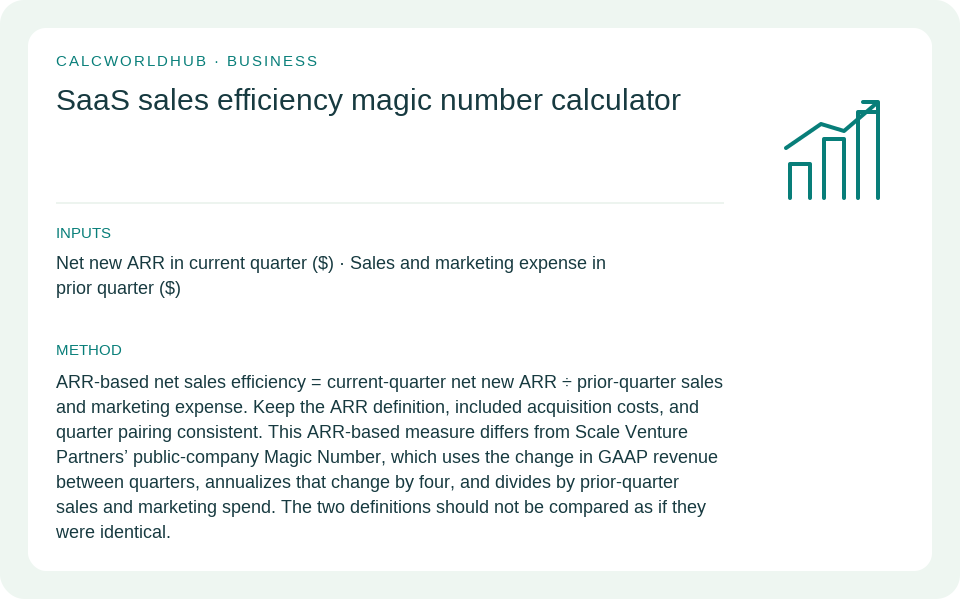
ARR-based net sales efficiency = current-quarter net new ARR ÷ prior-quarter sales and marketing expense. Keep the ARR definition, included acquisition costs, and quarter pairing consistent.
This ARR-based measure differs from Scale Venture Partners’ public-company Magic Number, which uses the change in GAAP revenue between quarters, annualizes that change by four, and divides by prior-quarter sales and marketing spend. The two definitions should not be compared as if they were identical.
A worked scenario
Net new ARR in current quarter ($) = 360000; Sales and marketing expense in prior quarter ($) = 300000.
- SaaS sales efficiency ratio: 1.2 ×
- Net new ARR per $1 spent: 1.2 $ / $
- ARR added: 360000 $ / quarter
$360,000 net new ARR divided by $300,000 prior-quarter sales and marketing expense gives 1.20×.
Assumptions and edge cases
This simple ratio is not a profitability or payback measure. It ignores gross margin, cash collection, retention, and the lag between spend and bookings.
Reading the outputs
The main result is SaaS sales efficiency ratio; supporting outputs are labeled with their own units. Use the units shown beside each input and result.
Frequently asked questions
What does the saas sales efficiency magic number calculate?
$360,000 net new ARR divided by $300,000 prior-quarter sales and marketing expense gives 1.20×.
Which inputs most affect saas sales efficiency ratio?
This ARR-based measure differs from Scale Venture Partners’ public-company Magic Number, which uses the change in GAAP revenue between quarters, annualizes that change by four, and divides by prior-quarter sales and marketing spend. The two definitions should not be compared as if they were identical.
Can this result replace a site-specific or measured value?
This simple ratio is not a profitability or payback measure. It ignores gross margin, cash collection, retention, and the lag between spend and bookings.
How do I use the SaaS sales efficiency magic number calculator?
Enter Net new ARR in current quarter ($), Sales and marketing expense in prior quarter ($). Match the units shown beside each field and review the result together with the assumptions below.
What is a worked example of SaaS sales efficiency magic number?
Net new ARR in current quarter ($) = 360000; Sales and marketing expense in prior quarter ($) = 300000. SaaS sales efficiency ratio: 1.2 × Net new ARR per $1 spent: 1.2 $ / $ ARR added: 360000 $ / quarter $360,000 net new ARR divided by $300,000 prior-quarter sales and marketing expense gives 1.20×.
Definition reference: Scale Venture Partners, A Primer on SaaS Sales Efficiency.
Read our calculation methodology.