How to use this calculator
Find the signed length of vector u along the direction of reference vector v, so the sign shows whether u points with or against that direction.
- Enter uₓ, uᵧ, u_z, vₓ, then complete the remaining labeled fields. Match the units shown beside each field and review the result together with the assumptions below.
- Read the worked example below to check the expected input format and result.
- Compare another scenario by changing one input at a time. Use Reset to return to the starting values.
How Scalar projection calculator works
Find the signed length of vector u along the direction of reference vector v, so the sign shows whether u points with or against that direction.
Inputs and units
- uₓ: x-coordinate of the vector u being projected.
- uᵧ: y-coordinate of the vector u being projected.
- u_z: z-coordinate of the vector u being projected.
- vₓ: x-coordinate of reference direction v; v must have nonzero length.
- vᵧ: y-coordinate of reference direction v.
- v_z: z-coordinate of reference direction v.
Formula and method
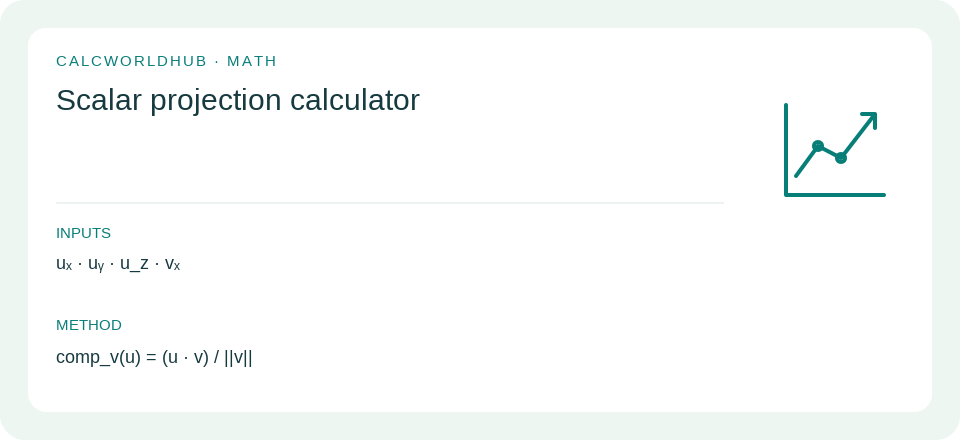
comp_v(u) = (u · v) / ||v||
Worked example
For u = (3, 4, 0) and v = (1, 0, 0), u · v = 3 and ||v|| = 1, so the scalar projection is 3 units.
Interpreting the result
A positive value means u has a component along v; a negative value means it points partly opposite v. The perpendicular part is not included.
Assumptions and limits
v cannot be the zero vector. Coordinates must use a common axis system; the scalar result has the same unit as the vector components when both vectors use that unit.
Sources and method
- Dot products, scalar and vector projections, cross products, and plane equations. OpenStax, Calculus Volume 3, Chapter 2 key equations
Frequently asked questions
What does the sign mean?
The sign records direction relative to v: positive is with v and negative is against v.
Is this the vector projection?
No. This result is a signed scalar length; vector projection also includes a direction vector.
How do I use the Scalar projection calculator?
Enter uₓ, uᵧ, u_z, vₓ, then complete the remaining labeled fields. Match the units shown beside each field and review the result together with the assumptions below.
What is a worked example of Scalar projection?
For u = (3, 4, 0) and v = (1, 0, 0), u · v = 3 and ||v|| = 1, so the scalar projection is 3 units.
What does the Scalar projection calculator calculate?
Find the signed length of vector u along the direction of reference vector v, so the sign shows whether u points with or against that direction.