How to use this calculator
Sum daily minimum and maximum temperatures into a crop-specific growing-degree total using the base and upper thresholds you provide.
- Enter Daily minimum temperatures (°C), Daily maximum temperatures (°C), Crop base temperature (°C), Upper temperature cap (°C). Match the units shown beside each field and review the result together with the assumptions below.
- Read the worked example below to check the expected input format and result.
- Compare another scenario by changing one input at a time. Use Reset to return to the starting values.
How this calculation works
Daily growing-degree units are useful on their own, but crop monitoring often needs the accumulated total across many days. Enter aligned temperature lists for the period and choose the base and upper thresholds used by your crop method.
Inputs and units
minimumsC— Daily minimum temperatures (°C)- Enter one daily minimum for each day, in chronological order.
maximumsC— Daily maximum temperatures (°C)- Enter one daily maximum for each day, aligned with the minimum-temperature list.
baseC— Crop base temperature (°C)- Growth below this lower threshold contributes zero in this calculation. Use a crop- and location-appropriate value.
upperC— Upper temperature cap (°C)- Daily temperatures are capped here before averaging; set the crop-specific upper threshold used by your method.
Formula
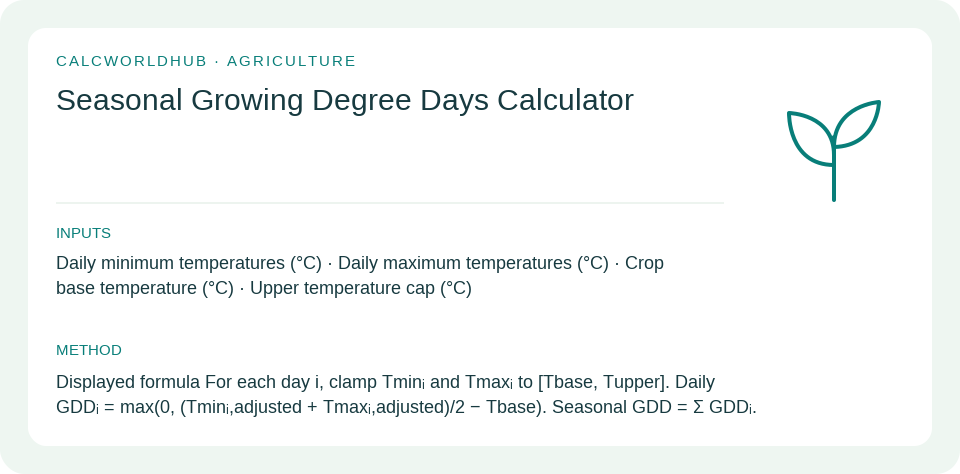
For each day i, clamp Tminᵢ and Tmaxᵢ to [Tbase, Tupper]. Daily GDDᵢ = max(0, (Tminᵢ,adjusted + Tmaxᵢ,adjusted)/2 − Tbase). Seasonal GDD = Σ GDDᵢ.
Method
The tool uses the simple average-temperature method with user-supplied lower and upper thresholds. Each minimum must not exceed its matching maximum, and both temperature lists must contain the same number of days.
Worked example
With base 10°C and cap 30°C, daily minimums 8, 12, 15°C and maximums 20, 28, 34°C give 5 + 10 + 12.5 = 27.5°C·days across three days.
Assumptions and limits
Base temperatures, upper caps, and accumulation rules vary by crop, cultivar, region, and model. This output does not predict a growth stage or date without a locally validated threshold or crop model.
Frequently asked questions
Why is there an upper temperature cap?
Some crop methods stop adding heat above a selected threshold. Use the cap specified by the crop model you are following.
Which base temperature should I use?
Choose the threshold documented for your crop, cultivar, and region. A generic base can produce a misleading seasonal total.
Does this predict flowering or harvest dates?
No. It totals thermal units only; stage timing needs a crop-specific model or locally validated GDD target.
How do I use the Seasonal Growing Degree Days Calculator?
Enter Daily minimum temperatures (°C), Daily maximum temperatures (°C), Crop base temperature (°C), Upper temperature cap (°C). Match the units shown beside each field and review the result together with the assumptions below.
What is a worked example of Seasonal Growing Degree Days?
With base 10°C and cap 30°C, daily minimums 8, 12, 15°C and maximums 20, 28, 34°C give 5 + 10 + 12.5 = 27.5°C·days across three days.
Reference: University of Minnesota Extension growing degree-day method for crop monitoring. See our calculation methodology.