Secant root iteration step calculator
Estimate one secant-method update from two x estimates and their function values.
Calculator
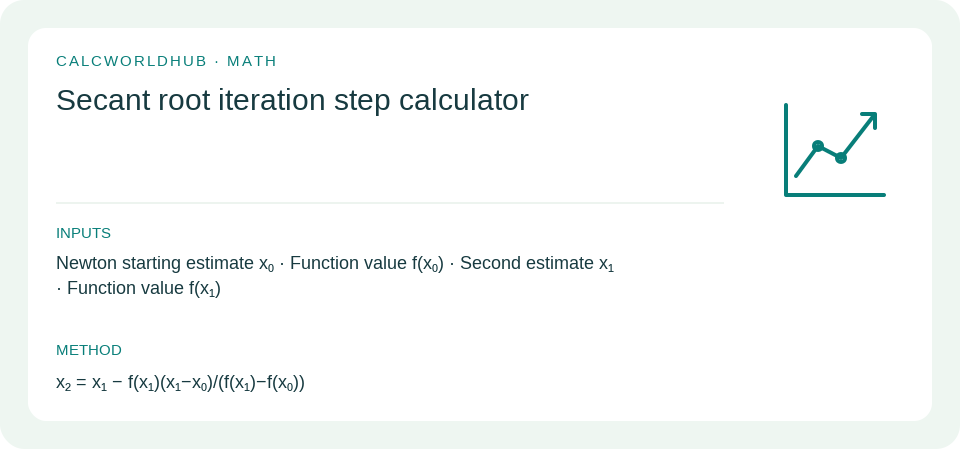
How to use this calculator
Estimate one secant-method update from two x estimates and their function values.
- Enter Newton starting estimate x₀, Function value f(x₀), Second estimate x₁, Function value f(x₁). Match the units shown beside each field and review the result together with the assumptions below.
- Read the worked example below to check the expected input format and result.
- Compare another scenario by changing one input at a time. Use Reset to return to the starting values.
Secant root iteration step calculator
Estimate one secant-method update from two x estimates and their function values.
Inputs and units
- Newton starting estimate x₀: First x-coordinate in the secant pair; it must be paired with the function value measured at exactly this estimate.
- Function value f(x₀): Evaluate the same function at the matching x estimate; these outputs must be on one consistent function scale and must differ for a finite secant step.
- Second estimate x₁: Second x-coordinate for the secant line; use a different estimate from the first and pair its own function value.
- Function value f(x₁): Evaluate the same function at the matching x estimate; these outputs must be on one consistent function scale and must differ for a finite secant step.
Formula and method
x₂ = x₁ − f(x₁)(x₁−x₀)/(f(x₁)−f(x₀))
Worked example
With x₀=1, f(x₀)=2, x₁=1.5 and f(x₁)=1, x₂=1.5−1(0.5)/(−1)=2.
Interpreting the result
This is the next estimate, not a guaranteed root. The method uses a secant slope in place of a derivative.
Assumptions and limits
The function values must differ; estimates and function outputs must be finite and consistently scaled. Convergence depends on the function and starting values.
Sources and method
- Explains iterative root-finding, the role of starting estimates, and why convergence is not guaranteed; the secant update is independently checked from its two-point slope. OpenStax Calculus Volume 1: Newton’s method
Frequently asked questions
Which inputs determine this result?
The visible inputs are Newton starting estimate x₀, Function value f(x₀), Second estimate x₁, Function value f(x₁). Each is used by the displayed formula; the calculator does not use any other hidden measurement.
When does this method apply?
The function values must differ; estimates and function outputs must be finite and consistently scaled. Convergence depends on the function and starting values.
How do I use the Secant root iteration step calculator?
Enter Newton starting estimate x₀, Function value f(x₀), Second estimate x₁, Function value f(x₁). Match the units shown beside each field and review the result together with the assumptions below.
What is a worked example of Secant root iteration step?
With x₀=1, f(x₀)=2, x₁=1.5 and f(x₁)=1, x₂=1.5−1(0.5)/(−1)=2.
What does the Secant root iteration step calculator calculate?
Estimate one secant-method update from two x estimates and their function values.
See the calculation methodology.
Good calculators show their work.
CalcWorldHub is built around clear inputs and visible assumptions. Results are estimates for planning; check official sources or your provider’s terms when exact figures matter.