How to use this calculator
Check a seed drill’s catch-tray output against a target seed rate using working width, drive-wheel travel, and rotations.
- Enter Effective drill width (m), Drive-wheel circumference (m), Wheel rotations during test, Target seed rate (kg/ha), then complete the remaining labeled fields. Match the units shown beside each field and review the result together with the assumptions below.
- Read the worked example below to check the expected input format and result.
- Compare another scenario by changing one input at a time. Use Reset to return to the starting values.
How this calculation works
A stationary calibration test can simulate a known travel distance by turning the drive wheel a measured number of rotations and collecting seed. The swept area and collected mass estimate the machine’s application rate, which can be compared with the target before field operation.
Inputs and units
width— Effective drill width (m)- Working width represented by the outlets included in the catch test.
circumference— Drive-wheel circumference (m)- Measured rolling circumference used to simulate travel distance.
rotations— Wheel rotations during test- Number of complete drive-wheel rotations for the collection test.
targetRate— Target seed rate (kg/ha)- Desired field application rate for the seed lot.
caughtGrams— Collected seed mass (g)- Total measured seed from the test outlets over the simulated travel.
Formula
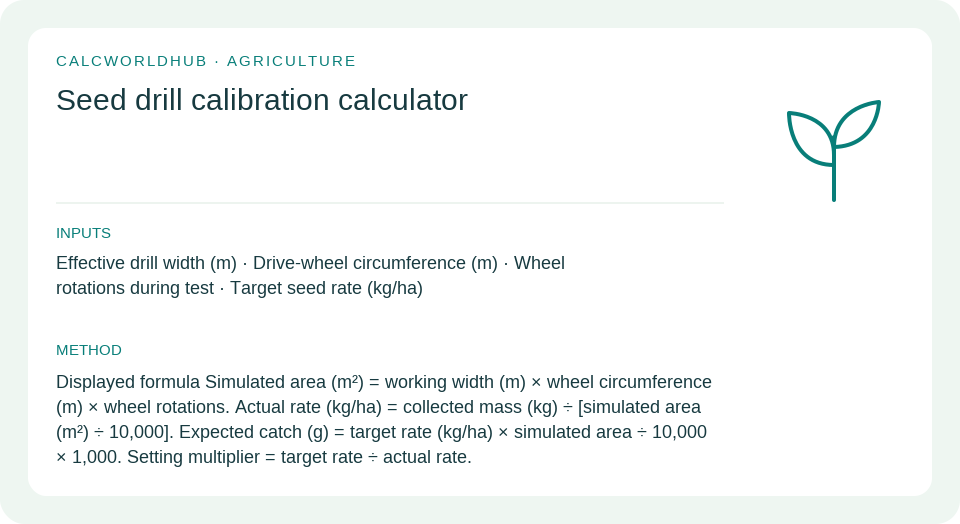
Simulated area (m²) = working width (m) × wheel circumference (m) × wheel rotations. Actual rate (kg/ha) = collected mass (kg) ÷ [simulated area (m²) ÷ 10,000]. Expected catch (g) = target rate (kg/ha) × simulated area ÷ 10,000 × 1,000. Setting multiplier = target rate ÷ actual rate.
Method
Measure effective working width and the circumference of the drive wheel, then rotate it the test count while collecting seed from the metering outlets. Enter collected mass in grams and compare the calculated rate with the target.
Worked example
With a 3 m drill, 2 m wheel circumference, 200 rotations, and a 180 kg/ha target, the test area is 1,200 m² (0.12 ha) and the expected catch is 21,600 g. A 20,500 g catch corresponds to about 170.83 kg/ha, so the target-to-actual setting multiplier is about 1.054.
Assumptions and limits
The estimate assumes wheel rotations represent ground travel without slip and that the collected outlets match the stated working width. Seed size, metering calibration, slope, field speed, and soil conditions can affect actual delivery; verify setup using the equipment manual and a field check.
Frequently asked questions
Why measure the drive-wheel circumference?
The circumference converts wheel rotations into simulated travel distance, which is needed to estimate the area covered.
Should I collect seed from every outlet?
The catch should represent the outlets and working width included in the test; follow the drill manufacturer’s calibration procedure.
Can I multiply the setting by the returned factor directly?
Treat it as an approximate adjustment indicator and verify with another catch test. Metering mechanisms may not respond linearly across settings.
How do I use the Seed drill calibration calculator?
Enter Effective drill width (m), Drive-wheel circumference (m), Wheel rotations during test, Target seed rate (kg/ha), then complete the remaining labeled fields. Match the units shown beside each field and review the result together with the assumptions below.
What is a worked example of Seed drill calibration?
With a 3 m drill, 2 m wheel circumference, 200 rotations, and a 180 kg/ha target, the test area is 1,200 m² (0.12 ha) and the expected catch is 21,600 g. A 20,500 g catch corresponds to about 170.83 kg/ha, so the target-to-actual setting multiplier is about 1.054.
Read our calculation methodology.