How to use this calculator
Apply two percentage discounts in sequence, then subtract a fixed coupon from the remaining price.
- Enter Listed price ($), First discount (%), Second discount (%), Fixed coupon ($). Match the units shown beside each field and review the result together with the assumptions below.
- Read the worked example below to check the expected input format and result.
- Compare another scenario by changing one input at a time. Use Reset to return to the starting values.
How this calculation works
A second percentage markdown applies to the already-reduced price, so successive percentages compound multiplicatively. The fixed coupon is applied last and cannot reduce the price below zero.
Inputs and units
listPrice— Listed price ($)- Original merchandise price before discounts.
discount1Pct— First discount (%)- First percentage reduction from the listed price.
discount2Pct— Second discount (%)- Second percentage reduction from the price remaining after discount one.
couponAmount— Fixed coupon ($)- Fixed coupon applied after both percentage discounts.
Formula
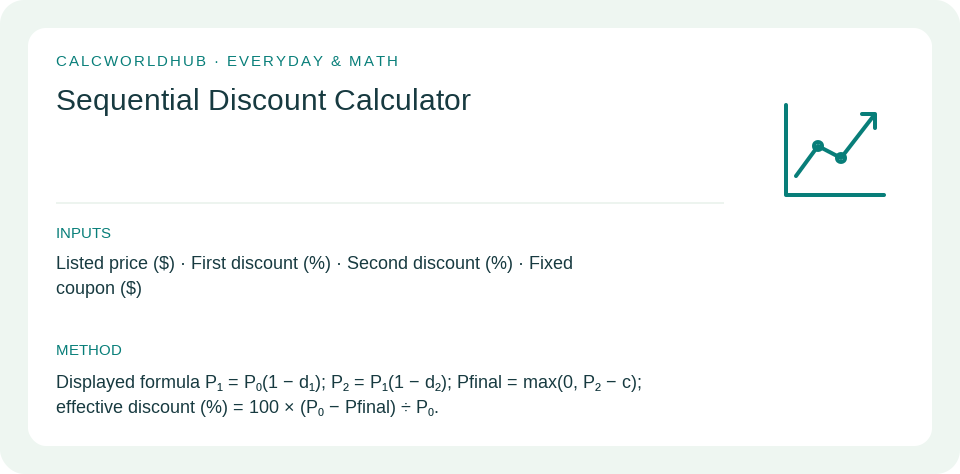
P₁ = P₀(1 − d₁); P₂ = P₁(1 − d₂); Pfinal = max(0, P₂ − c); effective discount (%) = 100 × (P₀ − Pfinal) ÷ P₀.
Method
P₀ is the listed price, d₁ and d₂ are discount percentages written as decimals, and c is a fixed coupon amount in the same currency. The coupon is capped at the price remaining after both percentage discounts.
Worked example
A $100 item reduced by 20%, then 10%, then a $5 coupon costs $67 before tax, a 33% effective discount: $100 × 0.80 × 0.90 − $5.
Assumptions and limits
Assumes both percentage discounts apply successively to the remaining merchandise price, then applies one fixed coupon. Tax, shipping, store-specific exclusions, and minimum-spend rules are not included.
Frequently asked questions
Do 20% and 10% discounts equal a 30% discount?
No. The second percentage applies to the reduced price, so 20% then 10% leaves 72% of the original price before any coupon.
What if the coupon is larger than the remaining price?
The final price is floored at zero and the unused coupon amount is reported.
Does this include sales tax or shipping?
No. The result is the merchandise price after the entered discounts and coupon only.
Can both percentage discounts be zero?
Yes. The final price then changes only if a fixed coupon is entered.
How do I use the Sequential Discount Calculator?
Enter Listed price ($), First discount (%), Second discount (%), Fixed coupon ($). Match the units shown beside each field and review the result together with the assumptions below.
Read our calculation methodology.