Short DNA oligo melting temperature calculator
Estimate a short oligonucleotide melting temperature with the Wallace rule. Enter your values below to see the result and method.
inputs.
How to use this calculator
Estimate a short oligonucleotide melting temperature with the Wallace rule.
- Enter A bases (count), T bases (count), G bases (count), C bases (count). Match the units shown beside each field and review the result together with the assumptions below.
- Read the worked example below to check the expected input format and result.
- Compare another scenario by changing one input at a time. Use Reset to return to the starting values.
Define the sequence or sample being analyzed
Use this molecular-biology tool to interpret sequence composition, amplification, or a measured DNA sample. Estimate a short oligonucleotide melting temperature with the Wallace rule.
Inputs and units
Enter the values below for this model. Count of adenine nucleotides in the oligo; it is one of four integer base counts. Count of thymine nucleotides in the oligo; it is one of four integer base counts. Count of guanine nucleotides in the oligo; it is one of four integer base counts. Count of cytosine nucleotides in the oligo; it is one of four integer base counts.
- A bases (count): Count of adenine nucleotides in the oligo; it is one of four integer base counts.
- T bases (count): Count of thymine nucleotides in the oligo; it is one of four integer base counts.
- G bases (count): Count of guanine nucleotides in the oligo; it is one of four integer base counts.
- C bases (count): Count of cytosine nucleotides in the oligo; it is one of four integer base counts.
Molecular biology formula and example
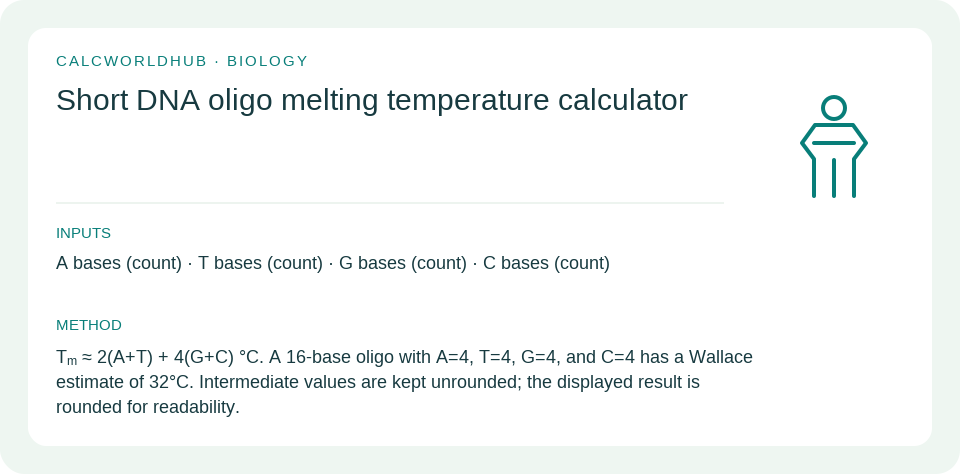
Tₘ ≈ 2(A+T) + 4(G+C) °C.
A 16-base oligo with A=4, T=4, G=4, and C=4 has a Wallace estimate of 32°C.
Intermediate values are kept unrounded; the displayed result is rounded for readability.
What the estimate includes
Sequence-based values depend on the exact fragment and filtering choices. Confirm whether the method expects single-stranded or double-stranded material and preserve the stated unit conversions.
Assumptions and limitations
Wallace is a rough short-oligo rule; salt, concentration, mismatches, and sequence context can materially change melting temperature.
Frequently asked questions
When is the Wallace melting-temperature rule a rough approximation?
Tₘ ≈ 2(A+T) + 4(G+C) °C. A 24-base oligo with A=6, T=5, G=7 and C=6 has a rough Tₘ of 74°C.
Which assumptions matter for this short dna oligo melting temperature?
Wallace is a rough short-oligo rule; salt, concentration, mismatches, and sequence context can materially change melting temperature.
How do I use the Short DNA oligo melting temperature calculator?
Enter A bases (count), T bases (count), G bases (count), C bases (count). Match the units shown beside each field and review the result together with the assumptions below.
What is a worked example of Short DNA oligo melting temperature?
Tₘ ≈ 2(A+T) + 4(G+C) °C. A 16-base oligo with A=4, T=4, G=4, and C=4 has a Wallace estimate of 32°C. Intermediate values are kept unrounded; the displayed result is rounded for readability.
What does the Short DNA oligo melting temperature calculator calculate?
Estimate a short oligonucleotide melting temperature with the Wallace rule.
Read the calculation methodology and privacy policy.
Source: Thermo Fisher Scientific: PCR primer melting-temperature calculations.