How to use this calculator
Find the centroid and centroidal area moments of a section assembled from axis-aligned solid rectangles and rectangular cutouts.
- Enter Rows centroid x y width height sign (mm). Match the units shown beside each field and review the result together with the assumptions below.
- Read the worked example below to check the expected input format and result.
- Compare another scenario by changing one input at a time. Use Reset to return to the starting values.
Signed rectangle composite area and inertia explained
This guide follows signed rectangle composite area and inertia calculator from its stated formula through a worked example, then identifies the assumptions that bound the result.
Inputs, symbols, and units
s— Rows centroid x y width height sign (mm)- Each row is center x, center y, width, height, sign. Use +1 for material and −1 for a cutout; coordinates and dimensions are millimetres. Use comma-separated values in the stated order.
Formula and method
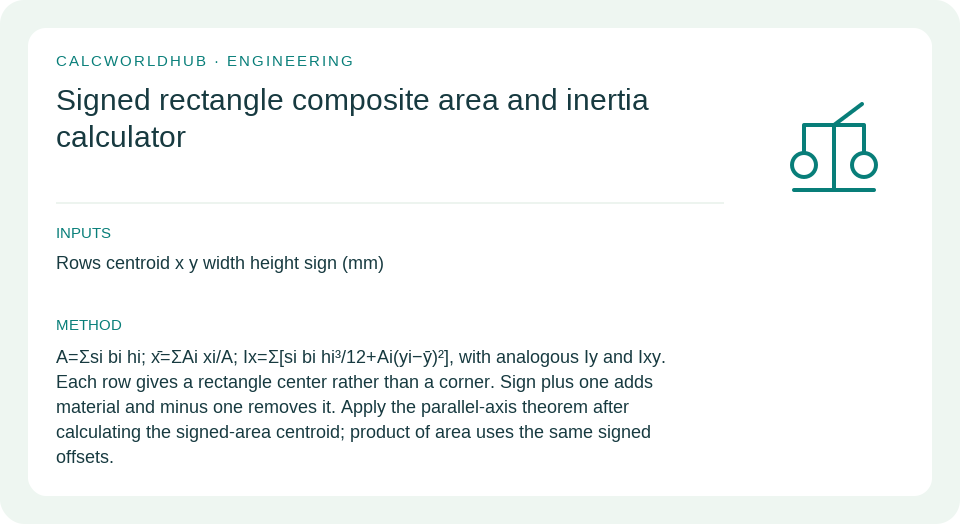
A=Σsi bi hi; x̄=ΣAi xi/A; Ix=Σ[si bi hi³/12+Ai(yi−ȳ)²], with analogous Iy and Ixy.
Each row gives a rectangle center rather than a corner. Sign plus one adds material and minus one removes it. Apply the parallel-axis theorem after calculating the signed-area centroid; product of area uses the same signed offsets.
A worked scenario
Rows centroid x y width height sign (mm) = 0,0,100,60,1,0,0,60,30,-1.
- Net section area: 4200 mm^2
- Centroid x: 0 mm
- Centroid y: 0 mm
- Centroidal second moment Ix: 1665000 mm^4
- Centroidal second moment Iy: 4460000 mm^4
- Centroidal product of area Ixy: 0 mm^4
A centered sixty-by-thirty cutout is removed from a hundred-by-sixty outer rectangle. Symmetry keeps the centroid at the origin while reducing both area moments.
Assumptions and edge cases
Axis-aligned rectangles, consistent millimetre units, positive net area, and positive section inertia. The user must ensure overlaps and holes represent a real section without double-counting. Rotated rectangles are not supported.
Reading the outputs
These are area moments in mm^4, not mass moments in kg m^2. They can supply a separate beam-deflection calculation when the section model is appropriate.
Frequently asked questions
What do x and y locate?
The center of each rectangle.
Can I make a T section?
Yes. Use nonoverlapping positive rectangles with their own centers.
Will the tool detect overlapping material?
No. It checks the algebraic section properties but cannot infer the intended construction.
How do I use the Signed rectangle composite area and inertia calculator?
Enter Rows centroid x y width height sign (mm). Match the units shown beside each field and review the result together with the assumptions below.
What is a worked example of Signed rectangle composite area and inertia?
Rows centroid x y width height sign (mm) = 0,0,100,60,1,0,0,60,30,-1. Net section area: 4200 mm^2 Centroid x: 0 mm Centroid y: 0 mm Centroidal second moment Ix: 1665000 mm^4 Centroidal second moment Iy: 4460000 mm^4 Centroidal product of area Ixy: 0 mm^4 A centered sixty-by-thirty cutout is removed from a hundred-by-sixty outer rectangle. Symmetry keeps the centroid at the origin while reducing both area moments.
Background or definition reference: MIT mechanics of materials background.
Read our calculation methodology.