How to use this calculator
Find the least-squares intercept of a straight-line fit from paired x and y observations.
- Enter X values, Y values. Match the units shown beside each field and review the result together with the assumptions below.
- Read the worked example below to check the expected input format and result.
- Compare another scenario by changing one input at a time. Use Reset to return to the starting values.
How Simple linear regression intercept calculator works
Find the least-squares intercept of a straight-line fit from paired x and y observations.
Inputs and units
- X values: Comma-separated predictor values x, paired by list position with y.
- Y values: Comma-separated response values y; use one value per x observation.
Formula and method
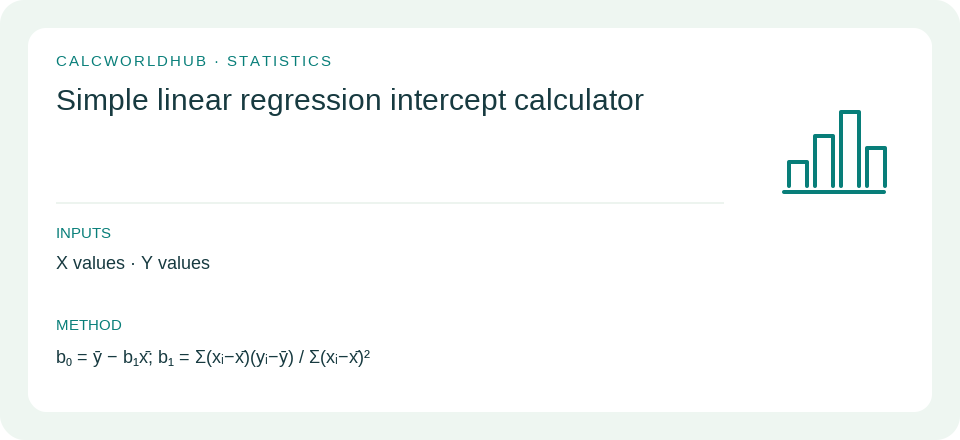
b₀ = ȳ − b₁x̄; b₁ = Σ(xᵢ−x̄)(yᵢ−ȳ) / Σ(xᵢ−x̄)²
Worked example
For x=(1,2,3,4) and y=(5,7,9,11), the fitted slope is 2 and intercept is ȳ−2x̄=8−2(2.5)=3.
Interpreting the result
The fitted line predicts y=b₀ when x=0. If zero is outside the observed x range, the intercept is an extrapolated model value.
Assumptions and limits
Lists must contain at least two paired values and x must vary. The intercept is descriptive of the fitted line, not automatically a meaningful real-world outcome at x=0.
Sources and method
- Least-squares regression and the assumptions behind uncertainty estimates. NIST/SEMATECH e-Handbook, Initial Linear Fit
Frequently asked questions
What is the intercept?
It is the fitted response at x=0.
Can it be misleading?
Yes. When x=0 is far outside the data range, the intercept is extrapolation rather than an observed condition.
How do I use the Simple linear regression intercept calculator?
Enter X values, Y values. Match the units shown beside each field and review the result together with the assumptions below.
What is a worked example of Simple linear regression intercept?
For x=(1,2,3,4) and y=(5,7,9,11), the fitted slope is 2 and intercept is ȳ−2x̄=8−2(2.5)=3.
What does the Simple linear regression intercept calculator calculate?
Find the least-squares intercept of a straight-line fit from paired x and y observations.