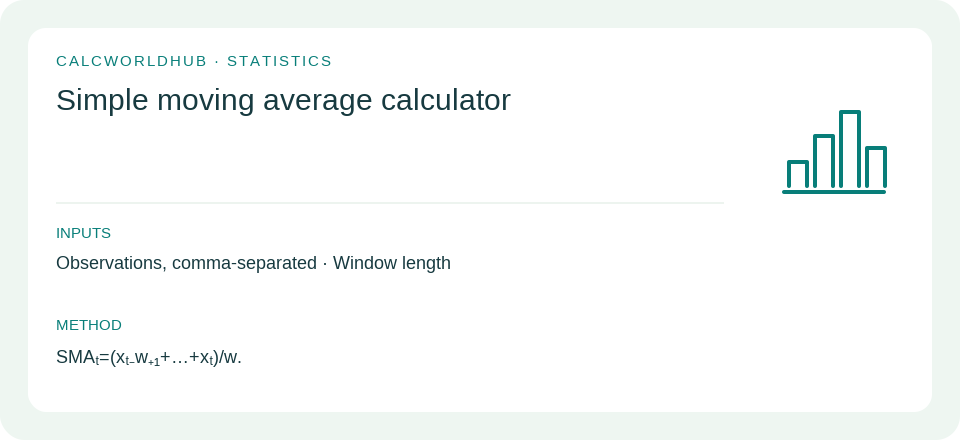
How to use this calculator
The simple moving average is the equal-weight mean of the most recent whole-number window of observations.
- Enter Observations, comma-separated, Window length. Match the units shown beside each field and review the result together with the assumptions below.
- Read the worked example below to check the expected input format and result.
- Compare another scenario by changing one input at a time. Use Reset to return to the starting values.
How Simple moving average calculator works
The simple moving average is the equal-weight mean of the most recent whole-number window of observations.
Inputs and units
- Observations, comma-separated: Enter finite observations in chronological order, oldest to newest; the calculator rejects blank or nonnumeric tokens.
- Window length: Window length is a whole-number count from one through the number of observations.
Formula and method
SMAₜ=(xₜ₋w₊₁+…+xₜ)/w.
Worked example
For 4, 7, 7, 10, 12 and a three-observation window, the latest average is (7+10+12)/3=29/3≈9.66667.
Interpreting the result
Each observation in the latest window contributes equally. A larger window smooths short-term variation but reacts more slowly to changes.
Assumptions and limits
The input order defines time order. The method contains no seasonal adjustment, trend model, missing-value imputation, or weighting by recency.
Frequently asked questions
What does the window length control?
It sets how many most recent observations are averaged.
Can I use a fractional window?
No. A window is a count of complete observations and must be a whole number.
How do I use the Simple moving average calculator?
Enter Observations, comma-separated, Window length. Match the units shown beside each field and review the result together with the assumptions below.
What is a worked example of Simple moving average?
For 4, 7, 7, 10, 12 and a three-observation window, the latest average is (7+10+12)/3=29/3≈9.66667.
What does the Simple moving average calculator calculate?
The simple moving average is the equal-weight mean of the most recent whole-number window of observations.