How to use this calculator
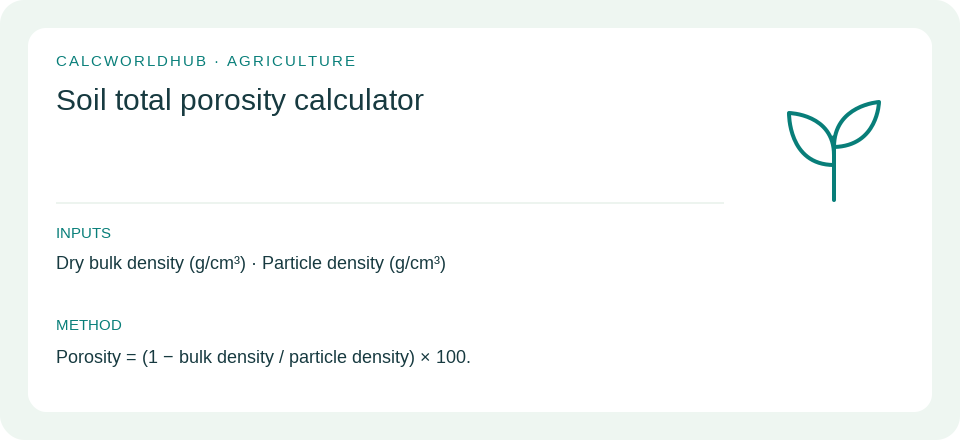
Estimate the fraction of a soil sample’s bulk volume occupied by pore space from two measured densities.
- Enter Dry bulk density (g/cm³), Particle density (g/cm³). Match the units shown beside each field and review the result together with the assumptions below.
- Read the worked example below to check the expected input format and result.
- Compare another scenario by changing one input at a time. Use Reset to return to the starting values.
Soil total porosity explained
Bulk density measures the soil solids and pore space together; comparing it with particle density estimates the fraction of total volume occupied by pores.
Inputs and units
- Dry bulk density (g/cm³)
- Dry soil mass per bulk soil volume.
- Particle density (g/cm³)
- Density of the solid soil particles.
Formula and method
Porosity = (1 − bulk density / particle density) × 100.
A worked example
Dry bulk density (g/cm³) = 1.35; Particle density (g/cm³) = 2.65.
- Total soil porosity: 49.06 %
With bulk density 1.35 g/cm³ and particle density 2.65 g/cm³, the estimated pore fraction is 49.06%; the result assumes both densities represent the same soil sample.
Assumptions and special cases
Total pore space does not reveal pore connectivity or plant-available water. Enter measured densities appropriate to the soil.
Ordinary density divides mass by volume. Porosity compares bulk and particle densities to infer empty volume.
Frequently asked questions
Is all pore space filled with water?
No. Pores can contain air or water.
Must particle density equal 2.65?
No. That default is an example; use the sample’s appropriate value.
Does high porosity guarantee good drainage?
No. Pore size and connectivity also matter.
How do I use the Soil total porosity calculator?
Enter Dry bulk density (g/cm³), Particle density (g/cm³). Match the units shown beside each field and review the result together with the assumptions below.
What is a worked example of Soil total porosity?
Dry bulk density (g/cm³) = 1.35; Particle density (g/cm³) = 2.65. Total soil porosity: 49.06 % With bulk density 1.35 g/cm³ and particle density 2.65 g/cm³, the estimated pore fraction is 49.06%; the result assumes both densities represent the same soil sample.
Method reference: FAO soil and water definitions (checked October 15, 2026).
See our calculation methodology.