How to use this calculator
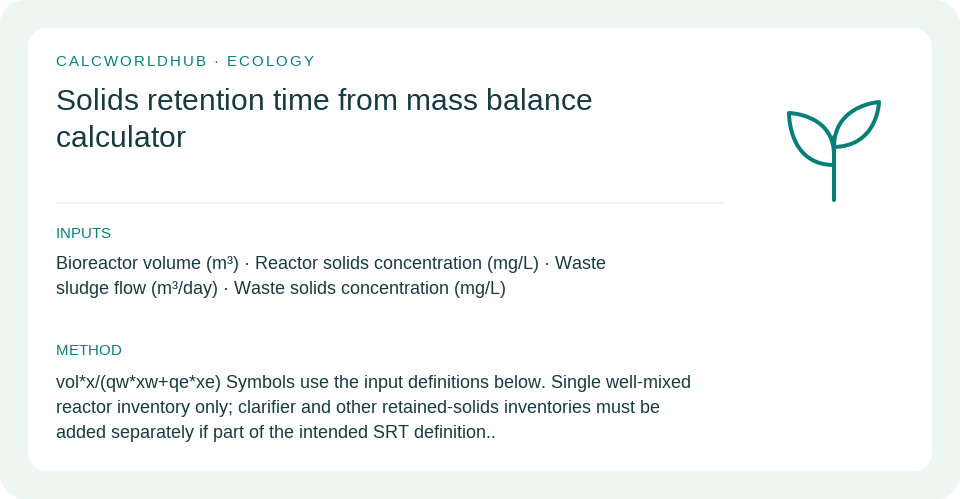
Divide reactor solids inventory by daily solids leaving in waste and effluent streams.
- Enter Bioreactor volume (m³), Reactor solids concentration (mg/L), Waste sludge flow (m³/day), Waste solids concentration (mg/L), then complete the remaining labeled fields. Match the units shown beside each field and review the result together with the assumptions below.
- Read the worked example below to check the expected input format and result.
- Compare another scenario by changing one input at a time. Use Reset to return to the starting values.
Solids retention time from mass balance explained
Use Bioreactor volume (m³) with Reactor solids concentration (mg/L) to reproduce the sample calculation, then review the stated limits before carrying the result into another scenario.
A numerical walkthrough
Bioreactor volume (m³) = 500; Reactor solids concentration (mg/L) = 3000; Waste sludge flow (m³/day) = 10; Waste solids concentration (mg/L) = 8000; Effluent flow (m³/day) = 990; Effluent solids concentration (mg/L) = 10.
- Reactor-inventory solids retention time: 16.685206 days
The 16.69 days is the entered reactor solids inventory divided by the daily solids leaving in waste sludge and effluent. The effluent term matters even when its concentration is low because it is multiplied by the large daily flow.
The model behind the numbers
vol*x/(qw*xw+qe*xe)
Symbols use the input definitions below. Single well-mixed reactor inventory only; clarifier and other retained-solids inventories must be added separately if part of the intended SRT definition..
What to enter
vol— Bioreactor volume (m³)- Bioreactor volume (m³).
x— Reactor solids concentration (mg/L)- Reactor solids concentration (mg/L).
qw— Waste sludge flow (m³/day)- Waste sludge flow (m³/day).
xw— Waste solids concentration (mg/L)- Waste solids concentration (mg/L).
qe— Effluent flow (m³/day)- Effluent flow (m³/day).
xe— Effluent solids concentration (mg/L)- Effluent solids concentration (mg/L).
Interpreting the result
Single well-mixed reactor inventory only; clarifier and other retained-solids inventories must be added separately if part of the intended SRT definition.
Sources
Frequently asked questions
Is SRT the hydraulic retention time?
No, solids and water can remain for different durations.
Can effluent solids be ignored?
Only if negligible for the intended estimate.
Is sludge return flow a solids loss?
No, an internal recycle is not a system outflow.
How do I use the Solids retention time from mass balance calculator?
Enter Bioreactor volume (m³), Reactor solids concentration (mg/L), Waste sludge flow (m³/day), Waste solids concentration (mg/L), then complete the remaining labeled fields. Match the units shown beside each field and review the result together with the assumptions below.
What is a worked example of Solids retention time from mass balance?
Bioreactor volume (m³) = 500; Reactor solids concentration (mg/L) = 3000; Waste sludge flow (m³/day) = 10; Waste solids concentration (mg/L) = 8000; Effluent flow (m³/day) = 990; Effluent solids concentration (mg/L) = 10. Reactor-inventory solids retention time: 16.685206 days The 16.69 days is the entered reactor solids inventory divided by the daily solids leaving in waste sludge and effluent. The effluent term matters even when its concentration is low because it is multiplied by the large daily flow.
Read our calculation methodology.