How to use this calculator
Free Spearman's rank correlation calculator. Measure the strength and direction of a monotonic relationship using paired ranked observations.
- Enter X values, comma-separated, Paired Y values. Match the units shown beside each field and review the result together with the assumptions below.
- Read the worked example below to check the expected input format and result.
- Compare another scenario by changing one input at a time. Use Reset to return to the starting values.
Measure whether paired values move together in rank order
Spearman’s rank correlation describes the direction and strength of a monotonic association between paired observations. It can capture consistently increasing or decreasing relationships that are not straight-line relationships.
Inputs for this calculation
- X values, comma-separated: The first measurement for each case.
- Paired Y values: The second measurement in the same row order; the two lists must have the same length.
Formula and method
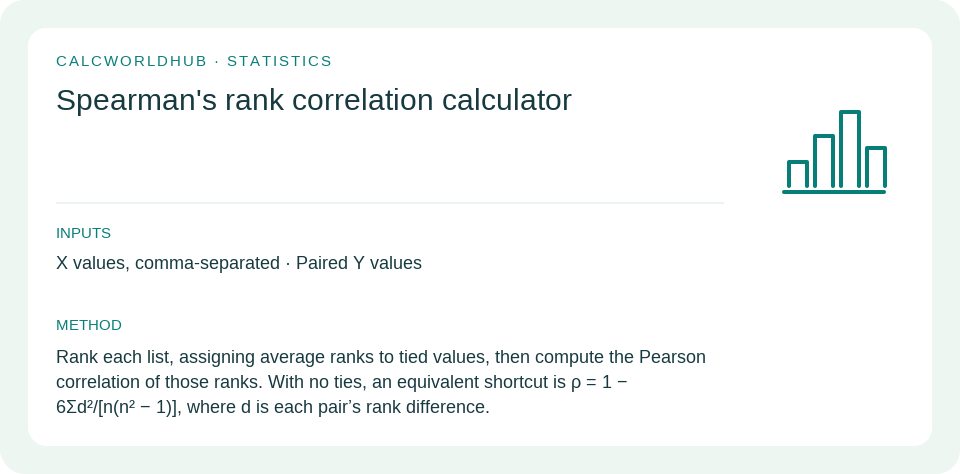
Rank each list, assigning average ranks to tied values, then compute the Pearson correlation of those ranks. With no ties, an equivalent shortcut is ρ = 1 − 6Σd²/[n(n² − 1)], where d is each pair’s rank difference.
Worked example
For X = 1, 2, 3, 4, 5 and Y = 1, 2, 4, 3, 5, the rank differences are 0, 0, −1, 1, 0, so Σd² = 2. The shortcut gives ρ = 1 − 6×2/[5×24] = 0.90.
Reading the result
The positive 0.90 indicates a strong increasing rank association in this small example. It does not mean the values follow a linear relationship, and correlation alone does not show that one variable causes the other.
Assumptions and limits
Ties are handled by average ranks; the no-tie shortcut above should not be applied unchanged when ties occur. The coefficient can be unstable with very small samples.
Method references
Frequently asked questions
Can Spearman correlation detect a curved relationship?
It can be high when the relationship is monotonic but curved. A non-monotonic pattern, such as a U-shape, may still produce a coefficient near zero.
How do I use the Spearman's rank correlation calculator?
Enter X values, comma-separated, Paired Y values. Match the units shown beside each field and review the result together with the assumptions below.
What is a worked example of Spearman's rank correlation?
For X = 1, 2, 3, 4, 5 and Y = 1, 2, 4, 3, 5, the rank differences are 0, 0, −1, 1, 0, so Σd² = 2. The shortcut gives ρ = 1 − 6×2/[5×24] = 0.90.
What does the Spearman's rank correlation calculator calculate?
Free Spearman's rank correlation calculator. Measure the strength and direction of a monotonic relationship using paired ranked observations.
What assumptions apply to Spearman's rank correlation?
Ties are handled by average ranks; the no-tie shortcut above should not be applied unchanged when ties occur. The coefficient can be unstable with very small samples.