Sphere surface-area-to-volume ratio calculator
Compare spherical surface area with enclosed volume using radius.
inputs.
Related calculators and articles
Compare methods and explore more free tools in biology.
How to use this calculator
Calculate the surface-area-to-volume ratio of a sphere from its radius.
- Enter Sphere radius. Match the units shown beside each field and review the result together with the assumptions below.
- Read the worked example below to check the expected input format and result.
- Compare another scenario by changing one input at a time. Use Reset to return to the starting values.
Compare a sphere’s surface exposure with its volume
For geometrically similar spheres, surface area per volume depends only on radius. The ratio rises as the sphere gets smaller, which is why scale can matter in heat, mass-transfer, and biological contexts.
Inputs and units
- Sphere radius: Positive radius measured in any length unit; the result uses the inverse of that same unit.
Formula and method
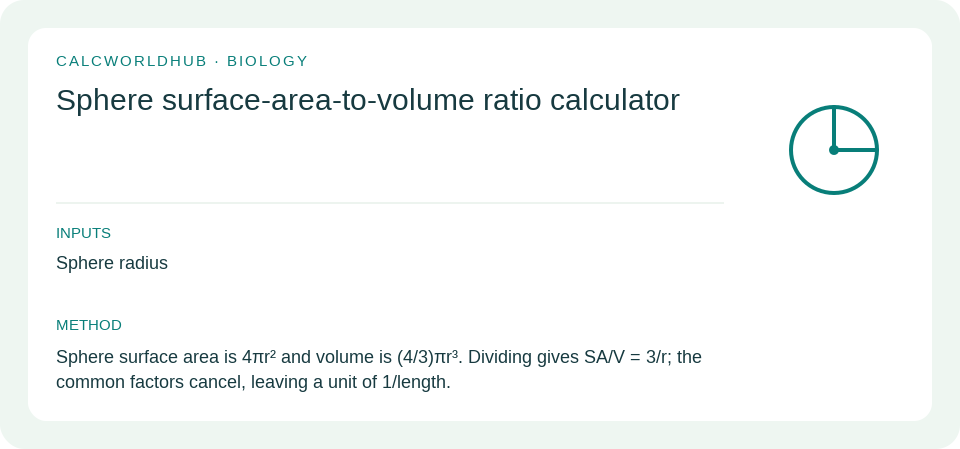
Sphere surface area is 4πr² and volume is (4/3)πr³. Dividing gives SA/V = 3/r; the common factors cancel, leaving a unit of 1/length.
Worked example
For radius r = 2.5 cm, SA/V = 3/2.5 = 1.2 cm⁻¹. The sphere’s surface area is about 78.54 cm² and volume about 65.45 cm³, whose ratio is also 1.2 cm⁻¹.
Interpreting the result
Each cubic centimeter of this ideal sphere corresponds to 1.2 square centimeters of surface. Doubling radius halves the ratio; it does not change the sphere’s shape.
Assumptions and limits
Assumes a perfect sphere and a single consistent length unit. The ratio alone does not predict a biological, thermal, or transport outcome without a model for the relevant process.
Frequently asked questions
Why does the unit contain inverse length?
Surface area has length squared and volume has length cubed, so their quotient has units of one divided by length.
How do I use the Sphere surface-area-to-volume ratio calculator?
Enter Sphere radius. Match the units shown beside each field and review the result together with the assumptions below.
What is a worked example of Sphere surface-area-to-volume ratio?
For radius r = 2.5 cm, SA/V = 3/2.5 = 1.2 cm⁻¹. The sphere’s surface area is about 78.54 cm² and volume about 65.45 cm³, whose ratio is also 1.2 cm⁻¹.
What does the Sphere surface-area-to-volume ratio calculator calculate?
Calculate the surface-area-to-volume ratio of a sphere from its radius.
What assumptions apply to Sphere surface-area-to-volume ratio?
Assumes a perfect sphere and a single consistent length unit. The ratio alone does not predict a biological, thermal, or transport outcome without a model for the relevant process.