Stair rise & run estimator
Estimate equal riser count and total stair run from the floor-to-floor rise.
inputs.
Calculator
How to use this calculator
Estimate equal stair risers and horizontal run from total rise, target riser height, and tread depth.
- Enter Total rise (in), Target maximum riser height (in), Tread depth (in). Match the units shown beside each field and review the result together with the assumptions below.
- Read the worked example below to check the expected input format and result.
- Compare another scenario by changing one input at a time. Use Reset to return to the starting values.
Estimate riser count and stair run
Divide a total vertical rise into equal risers no taller than a chosen target, then multiply the number of treads by tread depth.
Inputs and units
- Total rise (in): Vertical height from the finished lower floor to the finished upper floor.
- Target maximum riser height (in): The maximum rise you want the equal risers to approach.
- Tread depth (in): Horizontal depth assigned to each tread.
Formula and method
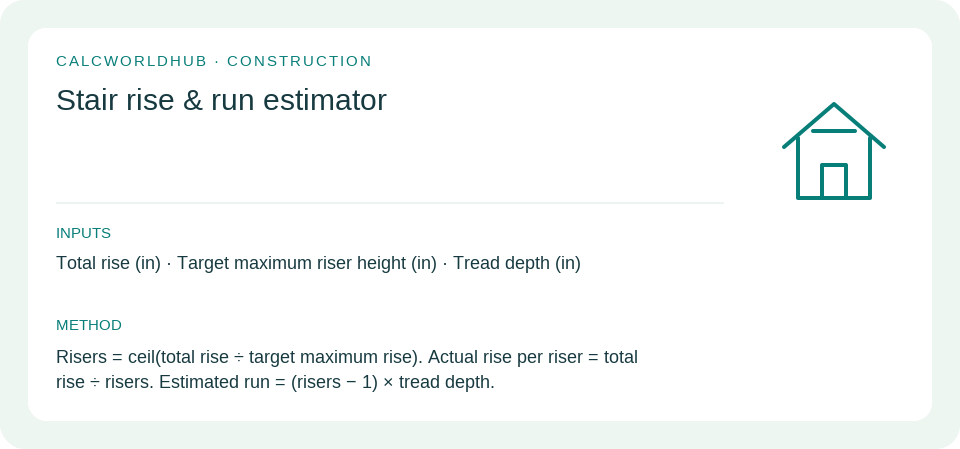
Risers = ceil(total rise ÷ target maximum rise). Actual rise per riser = total rise ÷ risers. Estimated run = (risers − 1) × tread depth.
Worked example
For a 108 in total rise, 7.5 in target, and 10 in treads: ceil(108/7.5)=15 risers; actual rise=7.2 in; 14 treads give 140 in estimated run.
Interpreting the result
The rounded riser count sets a uniform actual rise below or equal to the target. The run estimate counts the horizontal treads between the first and last riser.
Assumptions and limits
This is a layout estimate, not code approval. Headroom, landings, nosings, handrails, guards, finished surfaces, available floor space, and local requirements are excluded. Applicable accessible-stair rules cover specific settings and may not govern a private dwelling.
Method references
Frequently asked questions
Why are there fewer treads than risers?
The upper floor commonly acts as the landing after the last riser, so the simple run uses one fewer tread.
Can this replace a code check?
No. Verify dimensions and all applicable building requirements for the actual location.
How do I use the Stair rise & run estimator?
Enter Total rise (in), Target maximum riser height (in), Tread depth (in). Match the units shown beside each field and review the result together with the assumptions below.
What is a worked example of Stair rise & run estimator?
For a 108 in total rise, 7.5 in target, and 10 in treads: ceil(108/7.5)=15 risers; actual rise=7.2 in; 14 treads give 140 in estimated run.
What does the Stair rise & run estimator calculate?
Estimate equal stair risers and horizontal run from total rise, target riser height, and tread depth.
Good calculators show their work.
CalcWorldHub is built around clear inputs and visible assumptions. Results are estimates for planning; check official sources or your provider’s terms when exact figures matter.