How to use this calculator
This calculator reports Cohen’s d-style standardized mean difference using the supplied pooled standard deviation.
- Enter Mean group 1, Mean group 2, Pooled SD. Match the units shown beside each field and review the result together with the assumptions below.
- Read the worked example below to check the expected input format and result.
- Compare another scenario by changing one input at a time. Use Reset to return to the starting values.
How Standardized mean difference calculator works
This calculator reports Cohen’s d-style standardized mean difference using the supplied pooled standard deviation.
Inputs and units
- Mean group 1: Mean group 1 is the first group’s average.
- Mean group 2: Mean group 2 is the comparison group’s average.
- Pooled SD: Pooled SD is a positive within-group standard deviation in the outcome’s units.
Formula and method
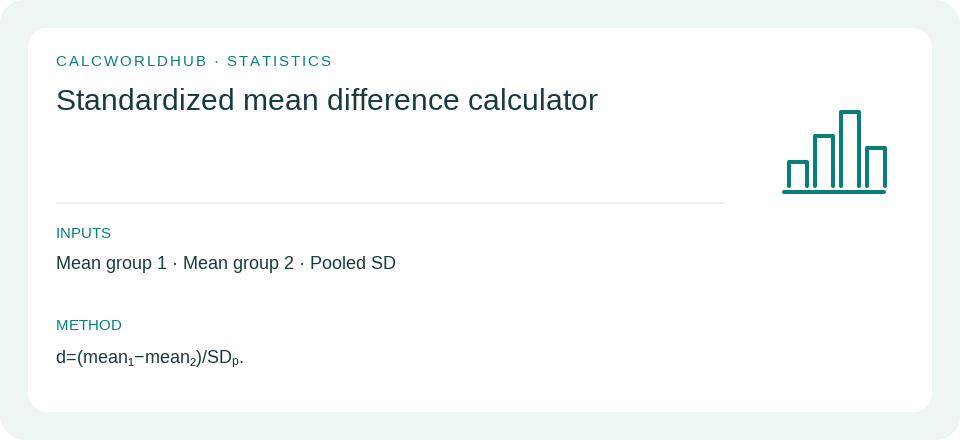
d=(mean₁−mean₂)/SDₚ.
Worked example
Means 55 and 50 with pooled SD 10 give d=(55−50)/10=0.5.
Interpreting the result
The positive sign means group 1’s mean is higher. The result is measured in pooled-standard-deviation units, not in the outcome’s original units.
Assumptions and limits
This is the unadjusted d ratio; it does not apply Hedges’ small-sample correction or provide a confidence interval. A common pooled SD assumes comparable within-group spreads.
Sources and method
- A standardized mean difference divides a group mean difference by a pooled standard deviation; interpretation depends on the outcome context. Cochrane Handbook: effect measures
Frequently asked questions
Is this Hedges’ g?
No. This page calculates the uncorrected standardized difference; Hedges’ g applies a small-sample correction.
Are effect-size cutoffs universal?
No. Interpretation depends on the outcome, field, and practical consequences.
How do I use the Standardized mean difference calculator?
Enter Mean group 1, Mean group 2, Pooled SD. Match the units shown beside each field and review the result together with the assumptions below.
What is a worked example of Standardized mean difference?
Means 55 and 50 with pooled SD 10 give d=(55−50)/10=0.5.
What does the Standardized mean difference calculator calculate?
This calculator reports Cohen’s d-style standardized mean difference using the supplied pooled standard deviation.