How to use this calculator
Fit an L2-penalized linear model after standardizing predictors, then translate the coefficients back to the original input units.
- Enter Predictor rows without intercept, Predictor columns per row, Matching responses, Ridge penalty on standardized coefficients. Match the units shown beside each field and review the result together with the assumptions below.
- Read the worked example below to check the expected input format and result.
- Compare another scenario by changing one input at a time. Use Reset to return to the starting values.
Standardized ridge regression coefficients explained
Each predictor column is centered and divided by its sample standard deviation before the L2-penalized fit; the intercept is left unpenalized. Coefficients are then rescaled to the original predictor units, so the stated lambda convention matters.
Inputs, symbols, and units
x— Predictor rows without intercept- Complete predictor rows flattened row by row. Omit the intercept; the application adds it automatically. Use a consistent unit within each predictor column. Use comma-separated values in the stated order.
p— Predictor columns per row- Number of predictor columns per observation before the automatic intercept. Every column must vary. Enter a whole number.
y— Matching responses- Ordered values in the role named above. Match row positions with other lists and use a consistent measurement unit within the same variable. Use comma-separated values in the stated order.
lambda— Ridge penalty on standardized coefficients- Positive L2 penalty applied to sample-SD standardized slopes under a sum-of-squares loss. The intercept is unpenalized.
Formula and method
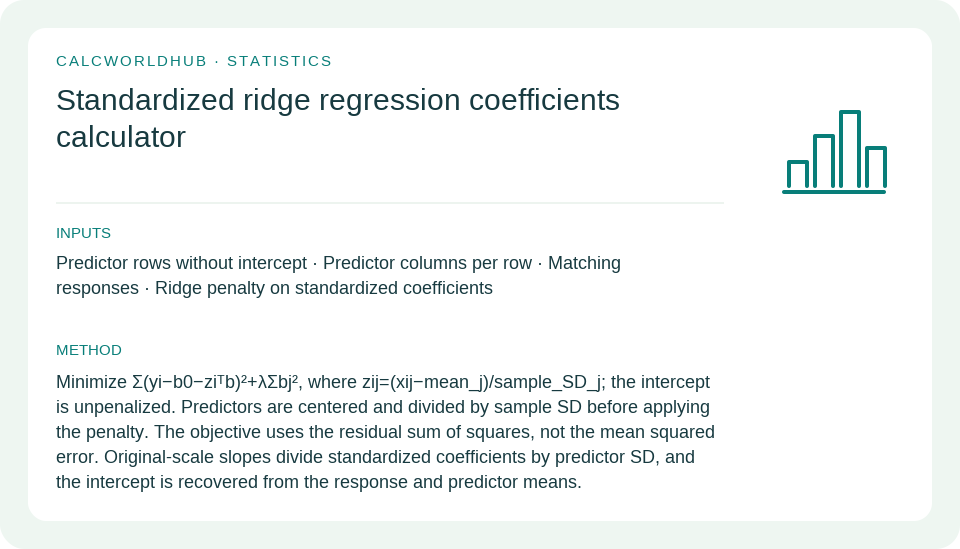
Minimize Σ(yi−b0−ziᵀb)²+λΣbj², where zij=(xij−mean_j)/sample_SD_j; the intercept is unpenalized.
Predictors are centered and divided by sample SD before applying the penalty. The objective uses the residual sum of squares, not the mean squared error. Original-scale slopes divide standardized coefficients by predictor SD, and the intercept is recovered from the response and predictor means.
A worked scenario
Predictor rows without intercept = 1,2,2,1,3,4,4,2,5,5,6,3,7,6,8,4; Predictor columns per row = 2; Matching responses = 4,5,9,8,13,12,18,16; Ridge penalty on standardized coefficients = 2.
- First original-scale ridge coefficient: 1.08606645 response units/predictor unit
- Original-scale coefficients: 1.08606645, 1.17191854
- Unpenalized intercept: 1.78247588 response units
- Training residual sum of squares: 5.49285395 squared response units
Both predictor columns in the example are standardized before lambda two is applied. Their different scales therefore do not set the penalty strength arbitrarily.
Assumptions and edge cases
All predictors must vary, with more observations than fitted coefficients. Lambda is supplied, not selected by validation. Training error is not a test-set performance estimate; no ordinary OLS p-values are attached to penalized coefficients.
Reading the outputs
The coefficient vector is in original predictor order and units. Compare predictions and validation error across penalties rather than interpreting shrinkage as evidence that a variable has no effect.
Frequently asked questions
Does lambda match every library?
Only when predictor scaling and the sum-versus-mean loss convention match.
Why is the intercept not shrunk?
Centering separates the mean response from penalized slopes.
Does this choose the best lambda?
No. Use validation or cross-validation outside this calculation.
How do I use the Standardized ridge regression coefficients calculator?
Enter Predictor rows without intercept, Predictor columns per row, Matching responses, Ridge penalty on standardized coefficients. Match the units shown beside each field and review the result together with the assumptions below.
What is a worked example of Standardized ridge regression coefficients?
Predictor rows without intercept = 1,2,2,1,3,4,4,2,5,5,6,3,7,6,8,4; Predictor columns per row = 2; Matching responses = 4,5,9,8,13,12,18,16; Ridge penalty on standardized coefficients = 2. First original-scale ridge coefficient: 1.08606645 response units/predictor unit Original-scale coefficients: 1.08606645, 1.17191854 Unpenalized intercept: 1.78247588 response units Training residual sum of squares: 5.49285395 squared response units Both predictor columns in the example are standardized before lambda two is applied. Their different scales therefore do not set the penalty strength arbitrarily.
Method reference: Statsmodels linear regression model definitions.
Read our calculation methodology.