How to use this calculator
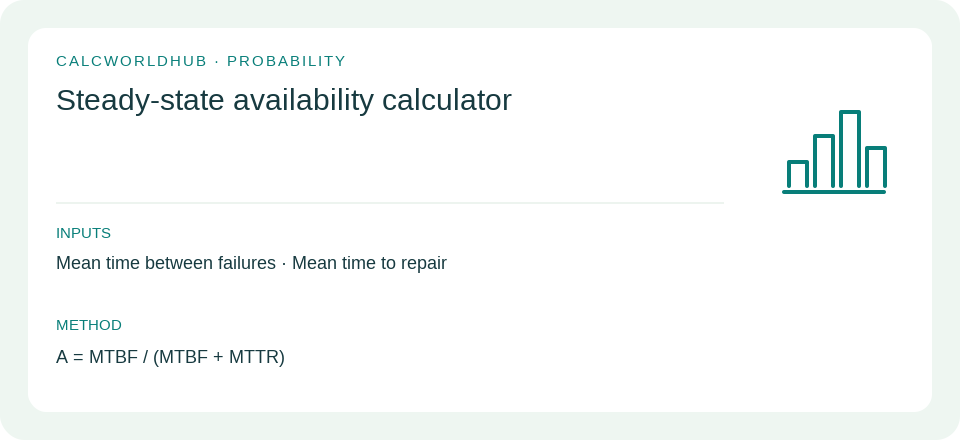
Estimate inherent steady-state availability from mean time between failures and mean time to repair. Both times must use the same unit.
- Enter Mean time between failures, Mean time to repair. Match the units shown beside each field and review the result together with the assumptions below.
- Read the worked example below to check the expected input format and result.
- Compare another scenario by changing one input at a time. Use Reset to return to the starting values.
How Steady-state availability calculator works
Estimate inherent steady-state availability from mean time between failures and mean time to repair. Both times must use the same unit.
Inputs and units
- Mean time between failures: Mean time between failures (MTBF), strictly positive.
- Mean time to repair: Mean time to repair (MTTR), nonnegative and in the same time unit as MTBF.
Formula and method
A = MTBF / (MTBF + MTTR)
Worked example
MTBF=100 hours and MTTR=4 hours give 100/104≈0.96154, or 96.15%.
Interpreting the result
The complement is the modeled repair fraction of the average operating-plus-repair cycle. Zero MTTR gives 100% in this simplified model.
Assumptions and limits
This inherent model excludes preventive maintenance, logistics, administrative delay, and other downtime; constant-rate assumptions and a stable repairable system are implicit.
Sources and method
- Inherent steady-state availability is MTBF divided by MTBF plus MTTR under the stated simplified model. NASA availability overview
Frequently asked questions
Why must MTBF and MTTR use the same units?
They are added in the denominator, so mixed units would make the ratio meaningless.
Does this equal operational availability?
Not necessarily. Operational availability includes additional downtime such as logistics and scheduled maintenance.
How do I use the Steady-state availability calculator?
Enter Mean time between failures, Mean time to repair. Match the units shown beside each field and review the result together with the assumptions below.
What is a worked example of Steady-state availability?
MTBF=100 hours and MTTR=4 hours give 100/104≈0.96154, or 96.15%.
What does the Steady-state availability calculator calculate?
Estimate inherent steady-state availability from mean time between failures and mean time to repair. Both times must use the same unit.