Stellar radius from luminosity and temperature calculator
Infer stellar radius in solar radii from bolometric luminosity and effective temperature using the stated 5,778 K normalization.
inputs.
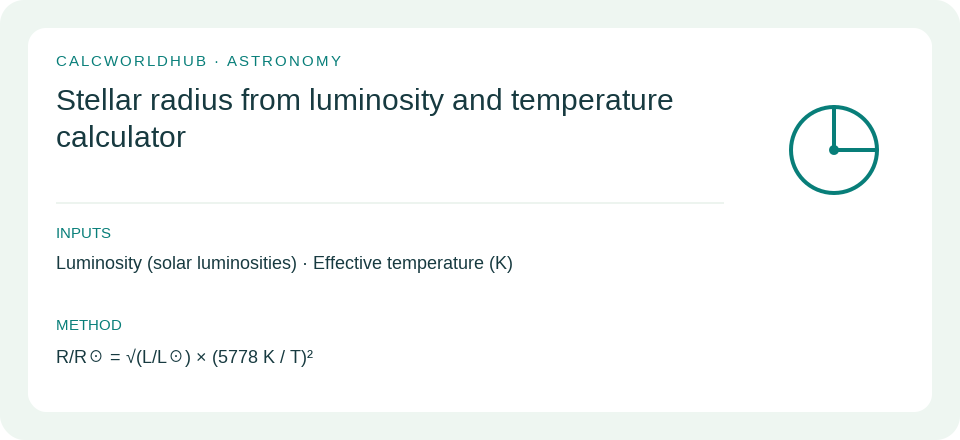
How to use this calculator
Infer stellar radius in solar radii from bolometric luminosity and effective temperature using the stated 5,778 K normalization.
- Enter Luminosity (solar luminosities), Effective temperature (K). Match the units shown beside each field and review the result together with the assumptions below.
- Read the worked example below to check the expected input format and result.
- Compare another scenario by changing one input at a time. Use Reset to return to the starting values.
How the Stellar radius from luminosity and temperature calculator works
Infer stellar radius in solar radii from bolometric luminosity and effective temperature using the stated 5,778 K normalization.
Inputs and units
- Luminosity (solar luminosities): Positive total luminosity in solar luminosities, not apparent flux.
- Effective temperature (K): Positive effective temperature in kelvins.
Formula and method
R/R☉ = √(L/L☉) × (5778 K / T)²
Worked example
At 16 L☉ and 8,000 K, radius = 4×(5778/8000)² = 2.08658025 R☉.
Interpreting the result
At fixed luminosity, a hotter star needs less emitting surface and therefore a smaller inferred radius.
Assumptions and limits
Uses spherical effective-temperature emission and bolometric luminosity. The rounded solar temperature is 5,778 K; this is not an angular-radius or distance calculation, and uncertainty in temperature strongly affects the result.
Sources and method
- Stefan–Boltzmann power scales with emitting area and the fourth power of absolute temperature. The 5,778 K normalization is the calculator assumption. OpenStax University Physics: blackbody radiation
Frequently asked questions
Can I enter brightness measured at Earth?
Not directly. Convert observed bolometric flux and distance to luminosity first, accounting for extinction where relevant.
Why is temperature squared in the radius formula?
Luminosity is proportional to R²T⁴. Solving for R takes the square root of both factors.
How do I use the Stellar radius from luminosity and temperature calculator?
Enter Luminosity (solar luminosities), Effective temperature (K). Match the units shown beside each field and review the result together with the assumptions below.
What is a worked example of Stellar radius from luminosity and temperature?
At 16 L☉ and 8,000 K, radius = 4×(5778/8000)² = 2.08658025 R☉.
What does the Stellar radius from luminosity and temperature calculator calculate?
Infer stellar radius in solar radii from bolometric luminosity and effective temperature using the stated 5,778 K normalization.
See the calculation methodology.