How to use this calculator
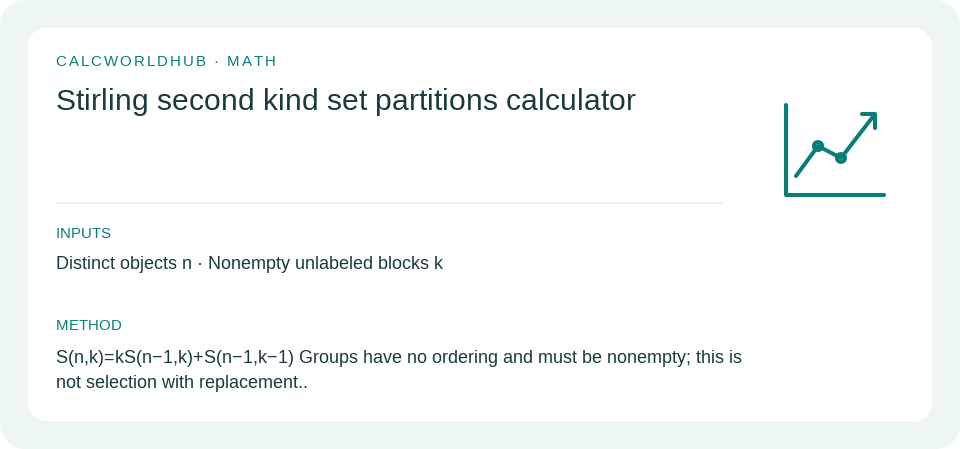
Count ways to partition n labeled objects into exactly k nonempty unlabeled groups.
- Enter Distinct objects n, Nonempty unlabeled blocks k. Match the units shown beside each field and review the result together with the assumptions below.
- Read the worked example below to check the expected input format and result.
- Compare another scenario by changing one input at a time. Use Reset to return to the starting values.
Stirling second kind set partitions explained
S(n,k) counts ways to partition n distinguishable objects into k nonempty groups when the groups themselves are unlabeled.
A numerical walkthrough
Distinct objects n = 5; Nonempty unlabeled blocks k = 3.
- Stirling S(n,k): 25
There are 25 partitions of five distinct objects into three nonempty unlabeled groups.
The model behind the numbers
S(n,k)=kS(n−1,k)+S(n−1,k−1)
Groups have no ordering and must be nonempty; this is not selection with replacement..
What to enter
n— Distinct objects n- Distinct objects n. Enter a whole number.
k— Nonempty unlabeled blocks k- Nonempty unlabeled blocks k. Enter a whole number.
Interpreting the result
Groups have no ordering and must be nonempty; this is not selection with replacement.
Frequently asked questions
Are the objects distinct?
Yes.
Are groups labeled?
No.
What if k exceeds n?
The answer is zero.
How do I use the Stirling second kind set partitions calculator?
Enter Distinct objects n, Nonempty unlabeled blocks k. Match the units shown beside each field and review the result together with the assumptions below.
What is a worked example of Stirling second kind set partitions?
Distinct objects n = 5; Nonempty unlabeled blocks k = 3. Stirling S(n,k): 25 There are 25 partitions of five distinct objects into three nonempty unlabeled groups.
Read our calculation methodology.