How to use this calculator
Reconstruct normalized Stokes parameters and total degree of polarization from calibrated complementary analyzer measurements.
- Enter Horizontal analyzer power, Vertical analyzer power, Plus 45 degree analyzer power, Minus 45 degree analyzer power, then complete the remaining labeled fields. Match the units shown beside each field and review the result together with the assumptions below.
- Read the worked example below to check the expected input format and result.
- Compare another scenario by changing one input at a time. Use Reset to return to the starting values.
Stokes polarization from six analyzer powers explained
Six ideal analyzer readings recover the Stokes components and the fraction of measured power carried by polarized light.
How the calculation works
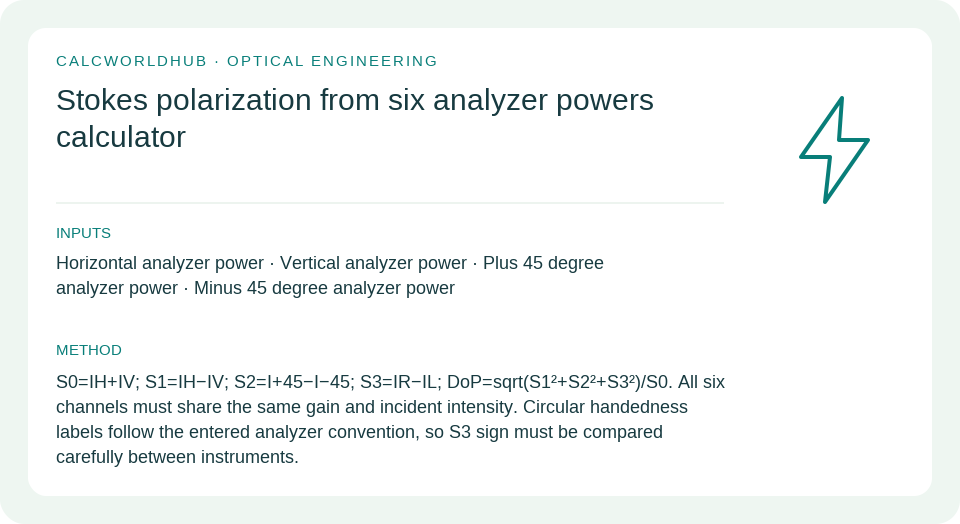
S0=IH+IV; S1=IH−IV; S2=I+45−I−45; S3=IR−IL; DoP=sqrt(S1²+S2²+S3²)/S0.
All six channels must share the same gain and incident intensity. Circular handedness labels follow the entered analyzer convention, so S3 sign must be compared carefully between instruments.
Set up the calculation
horizontal— Horizontal analyzer power- Measured power through the horizontal analyzer.
vertical— Vertical analyzer power- Measured power through the orthogonal vertical analyzer.
plus— Plus 45 degree analyzer power- Measured power through a linear analyzer at plus 45 degrees.
minus— Minus 45 degree analyzer power- Measured power through its orthogonal analyzer.
right— Right circular analyzer power- Power through the circular analyzer labeled right by your instrument.
left— Left circular analyzer power- Power through the complementary circular analyzer.
Limits of this model
Ideal calibrated analyzers and no time variation between measurements. No constrained noisy-data fitting; inconsistent pair sums or nonphysical degree are rejected.
Check this example
Horizontal analyzer power = 1; Vertical analyzer power = 0.5; Plus 45 degree analyzer power = 1.1; Minus 45 degree analyzer power = 0.4; Right circular analyzer power = 0.9; Left circular analyzer power = 0.6.
- Degree of polarization: 0.607362
- Normalized Stokes S1: 0.333333
- Normalized Stokes S2: 0.466667
- Normalized Stokes S3: 0.2
The default complementary pairs each sum to 1.5 units; their differences yield normalized Stokes components 1/3, 0.4667 and 0.2.
Reading the outputs
Degree and three normalized Stokes components are dimensionless. A fully unpolarized state gives zero degree and zero components.
Frequently asked questions
Why are the three pair sums checked?
Each complete orthogonal analyzer pair should account for the same total incident intensity.
Can the degree exceed one because of noise?
Raw measurements can imply that, but a physical Stokes estimate requires calibration or constrained fitting; this page rejects it.
Does right circular have one universal sign?
Handedness conventions vary, so match the analyzer and viewing-direction convention.
How do I use the Stokes polarization from six analyzer powers calculator?
Enter Horizontal analyzer power, Vertical analyzer power, Plus 45 degree analyzer power, Minus 45 degree analyzer power, then complete the remaining labeled fields. Match the units shown beside each field and review the result together with the assumptions below.
What is a worked example of Stokes polarization from six analyzer powers?
Horizontal analyzer power = 1; Vertical analyzer power = 0.5; Plus 45 degree analyzer power = 1.1; Minus 45 degree analyzer power = 0.4; Right circular analyzer power = 0.9; Left circular analyzer power = 0.6. Degree of polarization: 0.607362 Normalized Stokes S1: 0.333333 Normalized Stokes S2: 0.466667 Normalized Stokes S3: 0.2 The default complementary pairs each sum to 1.5 units; their differences yield normalized Stokes components 1/3, 0.4667 and 0.2.
Background or definition reference: MIT optics lecture notes.
Read our calculation methodology.