How to use this calculator
Return the positive two-sided Student t cutoff that leaves the requested central confidence level for the supplied degrees of freedom.
- Enter Degrees of freedom, Confidence level (%). Match the units shown beside each field and review the result together with the assumptions below.
- Read the worked example below to check the expected input format and result.
- Compare another scenario by changing one input at a time. Use Reset to return to the starting values.
How Student t critical value calculator works
Return the positive two-sided Student t cutoff that leaves the requested central confidence level for the supplied degrees of freedom.
Inputs and units
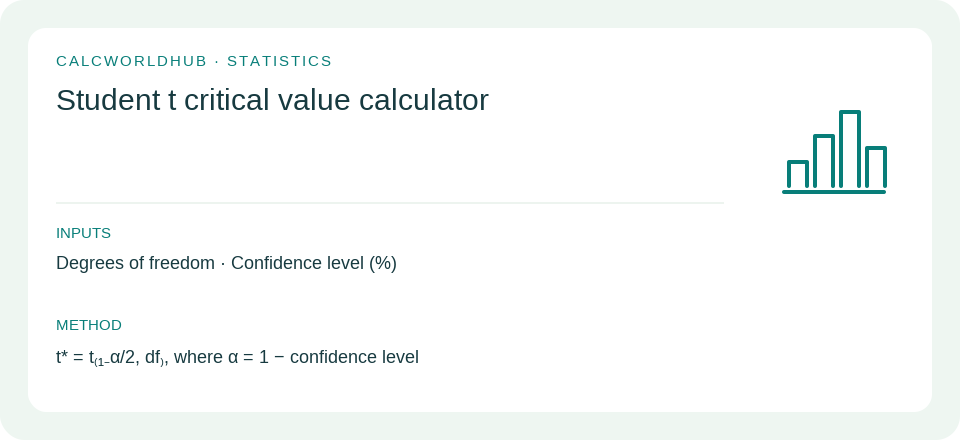
- Degrees of freedom: Positive degrees of freedom; classical t tests often use integers, while Welch-Satterthwaite methods can produce fractional values.
- Confidence level (%): Central confidence level as a percent; 95 requests 2.5% in each tail.
Formula and method
t* = t₍₁₋α/2, df₎, where α = 1 − confidence level
Worked example
At 95% confidence with 10 degrees of freedom, t*≈2.22814; the central interval is −2.22814 to +2.22814.
Interpreting the result
The critical value is a multiplier for a standard error in a t-based interval or test. It grows as confidence rises and generally shrinks as degrees of freedom increase.
Assumptions and limits
Degrees of freedom must be positive and confidence must lie strictly between 0% and 100%. Very extreme cutoffs outside the numerical search range are reported instead of returned as estimates.
Sources and method
- Student t tails, degrees-of-freedom behavior, and numerical critical values. NIST/SEMATECH e-Handbook, t Distribution
Frequently asked questions
Why is the value positive?
This calculator returns the upper cutoff for a symmetric two-sided interval; the lower cutoff is its negative.
Why does it depend on degrees of freedom?
Small samples have heavier t tails, so their critical values are larger than the normal cutoff.
How do I use the Student t critical value calculator?
Enter Degrees of freedom, Confidence level (%). Match the units shown beside each field and review the result together with the assumptions below.
What is a worked example of Student t critical value?
At 95% confidence with 10 degrees of freedom, t*≈2.22814; the central interval is −2.22814 to +2.22814.
What does the Student t critical value calculator calculate?
Return the positive two-sided Student t cutoff that leaves the requested central confidence level for the supplied degrees of freedom.