How to use this calculator
Check a closed polygon angle sum and distribute an equal correction across measured angles.
- Enter Measured interior angles (decimal degrees). Match the units shown beside each field and review the result together with the assumptions below.
- Read the worked example below to check the expected input format and result.
- Compare another scenario by changing one input at a time. Use Reset to return to the starting values.
How this calculation works
A closed polygon with n sides has a theoretical interior-angle sum of (n − 2) × 180 degrees. Surveyors compare the measured sum with this condition to find angular misclosure. When an equal-weight adjustment is appropriate, the correction is the negative misclosure divided by the number of measured angles.
Inputs and units
anglesDeg— Measured interior angles (decimal degrees)- Enter 3 to 50 measured interior angles for a single closed polygon; concave interior angles may exceed 180° but must be below 360°.
Formula
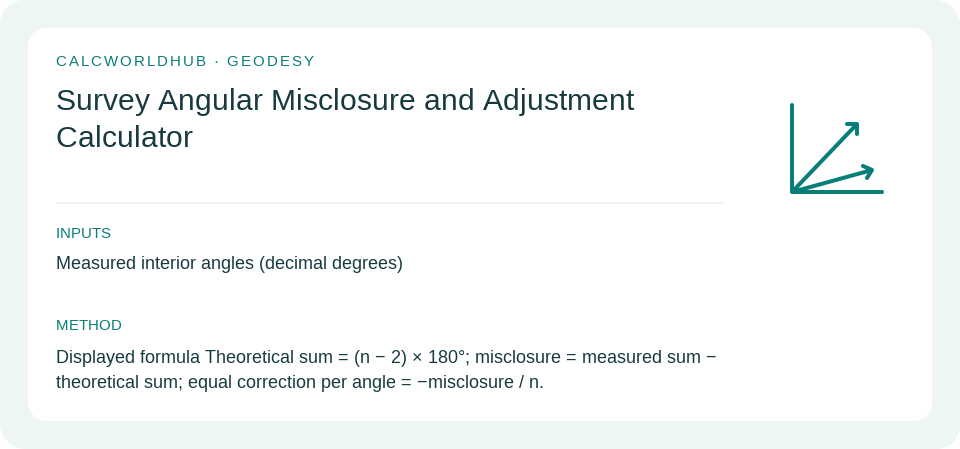
Theoretical sum = (n − 2) × 180°; misclosure = measured sum − theoretical sum; equal correction per angle = −misclosure / n.
Method
Enter the measured interior angles in decimal degrees for one closed polygon. The calculator computes the theoretical sum, signed misclosure, equal correction, and adjusted sum after distributing that correction evenly.
Worked example
For five measured angles totaling 540.01°, the theoretical sum is 540°. Misclosure is +0.01° and the equal correction is −0.002° per angle, giving an adjusted total of 540°.
Assumptions and limits
The equal correction assumes a simple closed polygon and equally weighted angle observations. It is not a least-squares adjustment and does not account for different instrument precision, traverse geometry, or angle covariance.
Frequently asked questions
What is angular misclosure?
It is the measured interior-angle sum minus the theoretical sum for the closed polygon.
How is the correction distributed?
This tool assigns the same correction, equal to negative misclosure divided by the number of angles, to every observation.
When should I avoid equal correction?
Use a weighted adjustment when observations have different precision or when the survey procedure requires a formal network adjustment.
How do I use the Survey Angular Misclosure and Adjustment Calculator?
Enter Measured interior angles (decimal degrees). Match the units shown beside each field and review the result together with the assumptions below.
What is a worked example of Survey Angular Misclosure and Adjustment?
For five measured angles totaling 540.01°, the theoretical sum is 540°. Misclosure is +0.01° and the equal correction is −0.002° per angle, giving an adjusted total of 540°.
Reference: UNSW surveying computations text on polygon angular misclosure and equal angle correction. See our calculation methodology.