How to use this calculator
Approximate ln(1+x) with its alternating Maclaurin series for −1<x≤1.
- Enter Input x (−1 < x ≤ 1), Number of terms (1–500). Match the units shown beside each field and review the result together with the assumptions below.
- Read the worked example below to check the expected input format and result.
- Compare another scenario by changing one input at a time. Use Reset to return to the starting values.
How Taylor ln(1+x) approximation calculator works
Approximate ln(1+x) with its alternating Maclaurin series for −1<x≤1.
Inputs and units
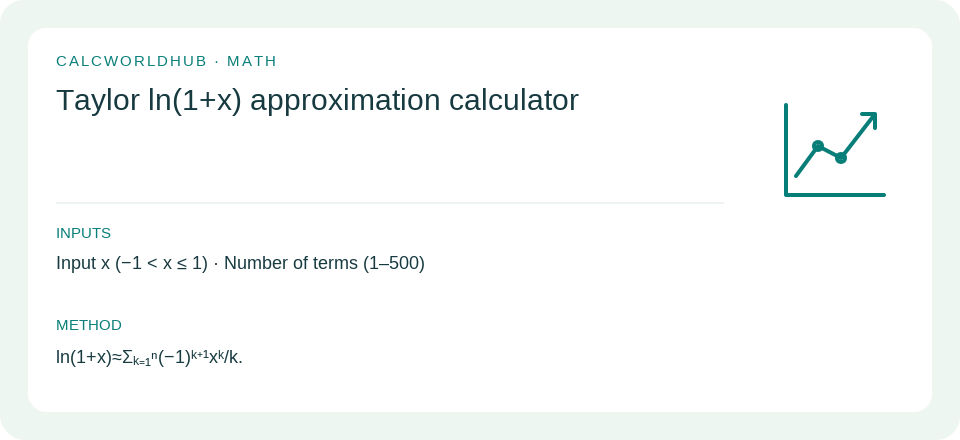
- Input x (−1 < x ≤ 1): x must be greater than −1 and no greater than 1.
- Number of terms (1–500): n is the number of included terms, starting at k=1.
Formula and method
ln(1+x)≈Σₖ₌₁ⁿ(−1)ᵏ⁺¹xᵏ/k.
Worked example
At x=0.5 and n=3, the estimate is 0.5−0.25/2+0.125/3≈0.416667.
Interpreting the result
For |x|<1, terms shrink geometrically; at x=1 the alternating harmonic series converges slowly to ln 2.
Assumptions and limits
x=−1 is excluded because ln(0) is undefined. Convergence is slow near x=1 and as x approaches −1; a finite sum has truncation error.
Sources and method
- Maclaurin polynomials for eˣ and ln(1+x) are derived, with convergence conditions discussed. OpenStax: Taylor and Maclaurin series
Frequently asked questions
Why does x=1 converge slowly?
The terms become the alternating harmonic series 1−1/2+1/3−…, whose terms decrease only as 1/k.
Why exclude x below −1?
The real logarithm ln(1+x) is undefined there.
How do I use the Taylor ln(1+x) approximation calculator?
Enter Input x (−1 < x ≤ 1), Number of terms (1–500). Match the units shown beside each field and review the result together with the assumptions below.
What is a worked example of Taylor ln(1+x) approximation?
At x=0.5 and n=3, the estimate is 0.5−0.25/2+0.125/3≈0.416667.
What does the Taylor ln(1+x) approximation calculator calculate?
Approximate ln(1+x) with its alternating Maclaurin series for −1<x≤1.