How to use this calculator
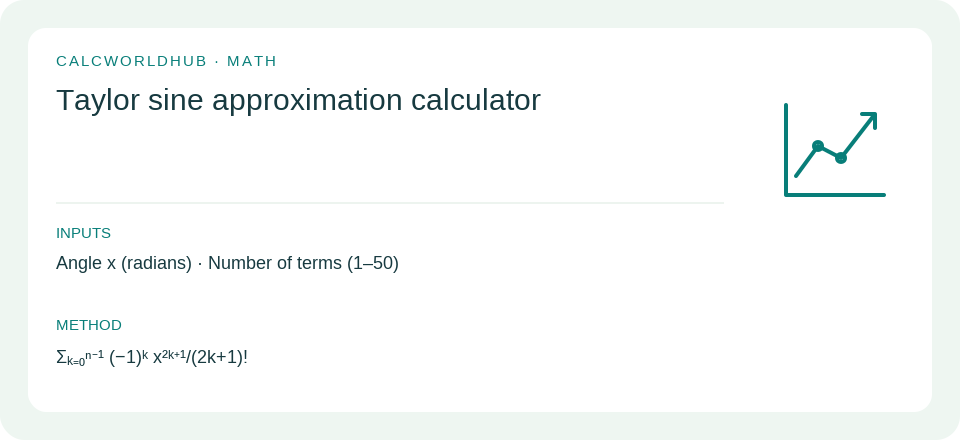
Approximate sin(x) using the first n Maclaurin terms. The series uses alternating odd powers of a radian angle.
- Enter Angle x (radians), Number of terms (1–50). Match the units shown beside each field and review the result together with the assumptions below.
- Read the worked example below to check the expected input format and result.
- Compare another scenario by changing one input at a time. Use Reset to return to the starting values.
How Taylor sine approximation calculator works
Approximate sin(x) using the first n Maclaurin terms. The series uses alternating odd powers of a radian angle.
Inputs and units
- Angle x (radians): Angle x in radians.
- Number of terms (1–50): Number of included terms n from 1 to 50.
Formula and method
Σₖ₌₀ⁿ⁻¹ (−1)ᵏ x²ᵏ⁺¹/(2k+1)!
Worked example
At x=0.5 radians with 8 terms, the approximation is approximately 0.4794255386.
Interpreting the result
The first term is x; later terms correct the estimate with alternating powers.
Assumptions and limits
The sine Maclaurin series converges for every finite x; the first omitted term bounds the alternating remainder once terms decrease in magnitude. For large |x|, cancellation can dominate floating-point arithmetic.
Sources and method
- Taylor approximations use derivatives at the expansion center; sine and cosine have alternating factorial-denominator series. OpenStax Taylor polynomials
Frequently asked questions
Does one term include x?
Yes. With n=1, the approximation is sin(x)≈x.
What units does the angle use?
Radians; convert degrees before entering the angle.
How do I use the Taylor sine approximation calculator?
Enter Angle x (radians), Number of terms (1–50). Match the units shown beside each field and review the result together with the assumptions below.
What is a worked example of Taylor sine approximation?
At x=0.5 radians with 8 terms, the approximation is approximately 0.4794255386.
What does the Taylor sine approximation calculator calculate?
Approximate sin(x) using the first n Maclaurin terms. The series uses alternating odd powers of a radian angle.