Telescope aperture limiting magnitude difference calculator
Estimate the ideal point-source limiting magnitude gain from changing aperture diameter. Enter your values below to see the result and method.
inputs.
Related calculators
These tools cover nearby questions while keeping this page focused on its own calculation.
How to use this calculator
Estimate the ideal point-source limiting magnitude gain from changing aperture diameter.
- Enter New aperture diameter (mm), Reference aperture diameter (mm). Match the units shown beside each field and review the result together with the assumptions below.
- Read the worked example below to check the expected input format and result.
- Compare another scenario by changing one input at a time. Use Reset to return to the starting values.
Identify the astronomical quantities
Estimate the ideal point-source magnitude gain from changing aperture diameter. The relation assumes equal transmission, sky, detector, and observing conditions.
Inputs and units
Enter positive new and reference diameters in the same unit; a larger new aperture gives a positive ideal gain.
- New aperture diameter (mm): Diameter of the new telescope's clear aperture.
- Reference aperture diameter (mm): Diameter of the comparison telescope's clear aperture.
Equation and checked example
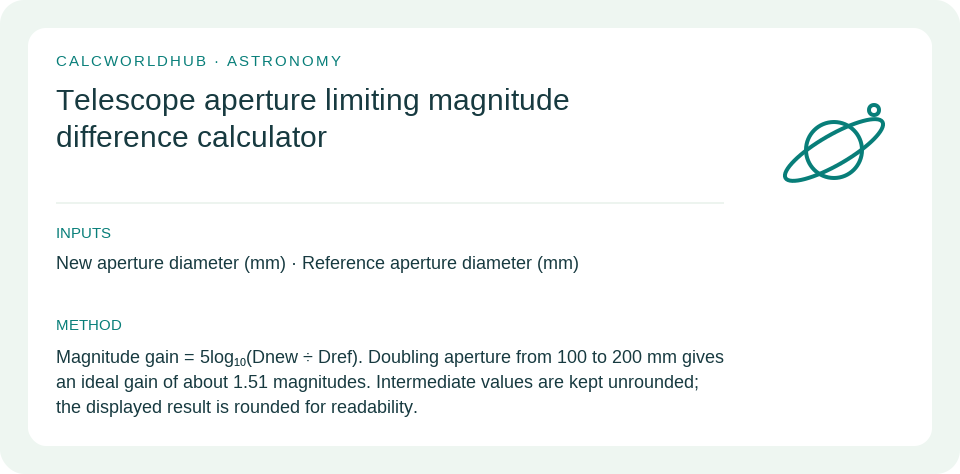
Magnitude gain = 5log₁₀(Dnew ÷ Dref).
Doubling aperture from 100 to 200 mm gives an ideal gain of about 1.51 magnitudes.
Intermediate values are kept unrounded; the displayed result is rounded for readability.
Interpreting the estimate
A positive value is the ideal magnitude gain of the larger new aperture relative to the reference aperture; practical limiting magnitude also depends on observing conditions.
Assumptions and limitations
Compares photon collection for ideal point sources under equal conditions; sky brightness, transmission, detector, and observer affect practical limits.
Frequently asked questions
Which values are needed for the telescope aperture limiting magnitude difference?
Enter positive new and reference diameters in the same unit; a larger new aperture gives a positive ideal gain.
Does this telescope aperture limiting magnitude difference include real-world effects?
Compares photon collection for ideal point sources under equal conditions; sky brightness, transmission, detector, and observer affect practical limits.
How do I use the Telescope aperture limiting magnitude difference calculator?
Enter New aperture diameter (mm), Reference aperture diameter (mm). Match the units shown beside each field and review the result together with the assumptions below.
What is a worked example of Telescope aperture limiting magnitude difference?
Magnitude gain = 5log₁₀(Dnew ÷ Dref). Doubling aperture from 100 to 200 mm gives an ideal gain of about 1.51 magnitudes. Intermediate values are kept unrounded; the displayed result is rounded for readability.
What does the Telescope aperture limiting magnitude difference calculator calculate?
Estimate the ideal point-source limiting magnitude gain from changing aperture diameter.
Read the calculation methodology and privacy policy.