How to use this calculator
Calculate a tennis player’s service hold percentage from service games held and played.
- Enter Service games held, Service games played. Match the units shown beside each field and review the result together with the assumptions below.
- Read the worked example below to check the expected input format and result.
- Compare another scenario by changing one input at a time. Use Reset to return to the starting values.
How this calculation works
A hold of serve occurs when a player wins a game in which they are serving. The hold percentage compares service games won with total service games in the same match or reporting period.
Inputs and units
serviceGamesHeld— Service games held- Service games in which the player won the game.
serviceGamesPlayed— Service games played- Total service games played by the same player in the period.
Formula
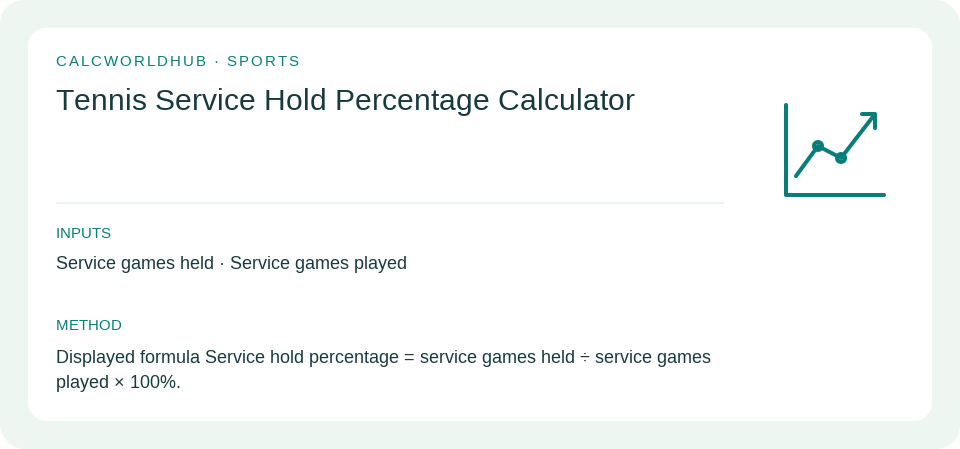
Service hold percentage = service games held ÷ service games played × 100%.
Method
Enter service games held and total service games played for the same player and reporting period.
Worked example
A player holds 13 of 15 service games: 13 ÷ 15 × 100 = 86.67%.
Assumptions and limits
Use one scoring source and period. Service games held cannot exceed service games played, and the played-game denominator must be greater than zero. This is a game-level statistic, not a service-point win percentage.
Frequently asked questions
What is a service hold?
A player holds serve by winning a game in which they served.
Does this count service points?
No. It uses service games won divided by service games played.
Can the result be above 100%?
No. Service games held cannot exceed service games played.
How do I use the Tennis Service Hold Percentage Calculator?
Enter Service games held, Service games played. Match the units shown beside each field and review the result together with the assumptions below.
What is a worked example of Tennis Service Hold Percentage?
A player holds 13 of 15 service games: 13 ÷ 15 × 100 = 86.67%.
Reference: Lawn Tennis Association glossary of serve, hold, break-point, and first-serve-point statistics. See our calculation methodology.