How to use this calculator
Assess whether three systematically refined numerical solutions approach a common limit. This is useful before quoting the last digits of a mesh-based result.
- Enter Coarse-grid quantity, Medium-grid quantity, Fine-grid quantity, Spacing refinement ratio. Match the units shown beside each field and review the result together with the assumptions below.
- Read the worked example below to check the expected input format and result.
- Compare another scenario by changing one input at a time. Use Reset to return to the starting values.
Three grid observed convergence order explained
Three solutions on successively refined grids can estimate an observed order when the refinement ratio is uniform and the differences approach an asymptotic regime. The calculator also extrapolates the fine-grid value toward the zero-spacing limit.
Inputs, symbols, and units
coarse— Coarse-grid quantity- Same scalar output computed on the coarsest mesh.
medium— Medium-grid quantity- Output after dividing mesh spacing by r.
fine— Fine-grid quantity- Output after a second spacing refinement by r.
r— Spacing refinement ratio- Coarse spacing divided by the next finer spacing.
Formula and method
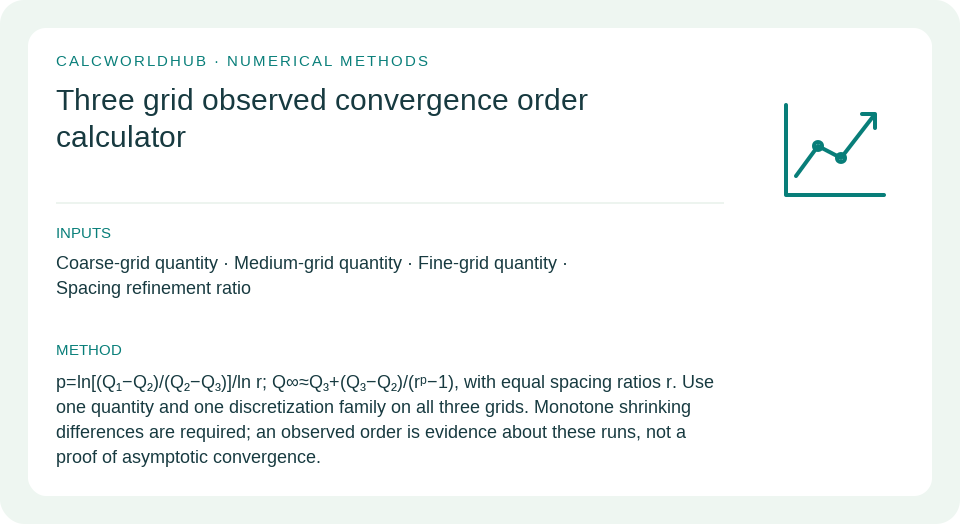
p=ln[(Q₁−Q₂)/(Q₂−Q₃)]/ln r; Q∞≈Q₃+(Q₃−Q₂)/(rᵖ−1), with equal spacing ratios r.
Use one quantity and one discretization family on all three grids. Monotone shrinking differences are required; an observed order is evidence about these runs, not a proof of asymptotic convergence.
A worked scenario
Coarse-grid quantity = 1.08; Medium-grid quantity = 1.02; Fine-grid quantity = 1.005; Spacing refinement ratio = 2.
- Observed order: 2
- Extrapolated limit: 1
- Fine-grid error estimate: 0.005
Outputs 1.08, 1.02 and 1.005 on successively halved grids imply second-order convergence and an extrapolated limit of 1.
Assumptions and edge cases
Oscillatory sequences, changing models, roundoff-dominated results and unequal spacing ratios are not supported. The error is an asymptotic estimate, not a rigorous bound.
Reading the outputs
The order is dimensionless; the extrapolated value and estimated absolute fine-grid error retain the units of the supplied quantity.
Frequently asked questions
Can I use cell counts instead of spacing?
Only convert counts to a consistent linear spacing ratio first; a doubled two-dimensional cell count does not halve spacing.
Why reject alternating differences?
The single-power monotone error model does not describe an oscillating convergence sequence.
Does a high order prove accuracy?
No. Three nearby outputs can agree while sharing a modeling error.
How do I use the Three grid observed convergence order calculator?
Enter Coarse-grid quantity, Medium-grid quantity, Fine-grid quantity, Spacing refinement ratio. Match the units shown beside each field and review the result together with the assumptions below.
What is a worked example of Three grid observed convergence order?
Coarse-grid quantity = 1.08; Medium-grid quantity = 1.02; Fine-grid quantity = 1.005; Spacing refinement ratio = 2. Observed order: 2 Extrapolated limit: 1 Fine-grid error estimate: 0.005 Outputs 1.08, 1.02 and 1.005 on successively halved grids imply second-order convergence and an extrapolated limit of 1.
Background or definition reference: NIST DLMF numerical methods.
Read our calculation methodology.