How to use this calculator
Add three resistor-weighted input voltages with an ideal inverting summing amplifier.
- Enter First input (V), Second input (V), Third input (V), First input resistor (kΩ), then complete the remaining labeled fields. Match the units shown beside each field and review the result together with the assumptions below.
- Read the worked example below to check the expected input format and result.
- Compare another scenario by changing one input at a time. Use Reset to return to the starting values.
Three input inverting summing amplifier explained
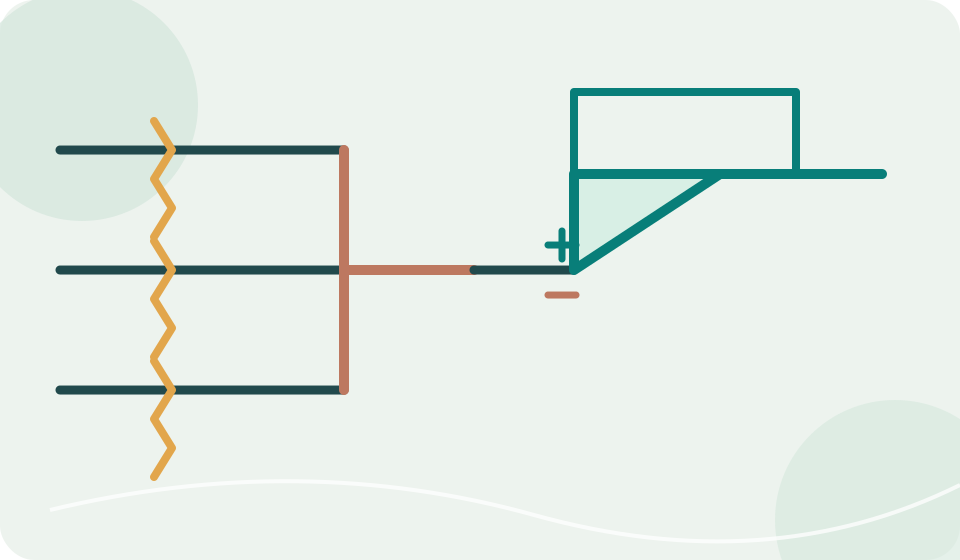
Each input contributes to the output according to its resistor ratio. The inverting stage sums those weighted voltages and assumes the op amp remains in its linear operating region.
Inputs, symbols, and units
a— First input (V)- First input (V).
b— Second input (V)- Second input (V).
c— Third input (V)- Third input (V).
r— First input resistor (kΩ)- First input resistor (kΩ).
s— Second input resistor (kΩ)- Second input resistor (kΩ).
t— Third input resistor (kΩ)- Third input resistor (kΩ).
f— Feedback resistor (kΩ)- Feedback resistor (kΩ).
Formula and method
Vout=−Rf(V1/R1+V2/R2+V3/R3).
Symbols use the input definitions below. Assumes a virtual-ground summing node, negligible bias current, and no output clipping..
A worked scenario
First input (V) = 0.2; Second input (V) = 0.3; Third input (V) = -0.1; First input resistor (kΩ) = 10; Second input resistor (kΩ) = 20; Third input resistor (kΩ) = 10; Feedback resistor (kΩ) = 30.
- Three input inverting summing amplifier: -0.75 V
This scenario uses the stated units and assumptions. Displayed values are rounded only after calculation.
Assumptions and edge cases
Assumes a virtual-ground summing node, negligible bias current, and no output clipping.
Frequently asked questions
Must the input resistors match?
No, their values set independent weights.
Can one input be negative?
Yes, use its signed voltage.
Is the result a simple average?
Only with an intentionally selected resistor ratio.
How do I use the Three input inverting summing amplifier calculator?
Enter First input (V), Second input (V), Third input (V), First input resistor (kΩ), then complete the remaining labeled fields. Match the units shown beside each field and review the result together with the assumptions below.
What is a worked example of Three input inverting summing amplifier?
First input (V) = 0.2; Second input (V) = 0.3; Third input (V) = -0.1; First input resistor (kΩ) = 10; Second input resistor (kΩ) = 20; Third input resistor (kΩ) = 10; Feedback resistor (kΩ) = 30. Three input inverting summing amplifier: -0.75 V This scenario uses the stated units and assumptions. Displayed values are rounded only after calculation.
Method reference: Texas Instruments analog circuit cookbook.
Read our calculation methodology.