Three resistor parallel calculator
Find the equivalent resistance of three resistors connected across the same two nodes in parallel.
inputs.
How to use this calculator
Find the equivalent resistance of three resistors connected across the same two nodes in parallel.
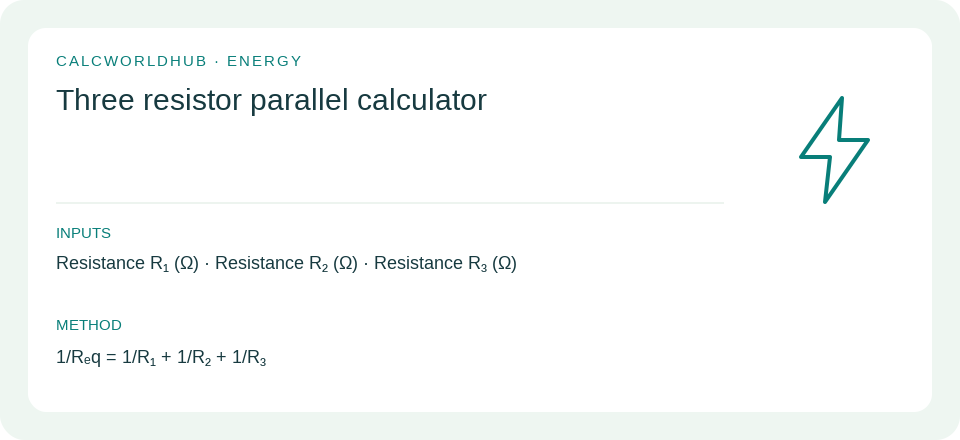
- Enter Resistance R₁ (Ω), Resistance R₂ (Ω), Resistance R₃ (Ω). Match the units shown beside each field and review the result together with the assumptions below.
- Read the worked example below to check the expected input format and result.
- Compare another scenario by changing one input at a time. Use Reset to return to the starting values.
How the Three resistor parallel calculator works
Find the equivalent resistance of three resistors connected across the same two nodes in parallel.
Inputs and units
- Resistance R₁ (Ω): First branch resistance in ohms; all three branches are modeled as positive resistors.
- Resistance R₂ (Ω): Second branch resistance in ohms.
- Resistance R₃ (Ω): Third branch resistance in ohms.
Formula and method
1/Rₑq = 1/R₁ + 1/R₂ + 1/R₃
Worked example
For 100 Ω, 220 Ω, and 330 Ω, Rₑq = 1/(1/100+1/220+1/330) ≈ 56.90 Ω.
Interpreting the result
The equivalent resistance is lower than the smallest positive branch resistance because each parallel branch adds conductance.
Assumptions and limits
Assumes passive ohmic resistors. A zero-ohm branch is an ideal short and yields zero equivalent resistance; negative resistance is outside this passive-resistor model. Real component tolerance, temperature, wiring, and power ratings are not modeled.
Sources and method
- Parallel conductances add; this yields the reciprocal-sum equivalent resistance. OpenStax College Physics 2e: resistors in series and parallel
Frequently asked questions
Why is the equivalent resistance below 100 Ω in the example?
Parallel branches add conductance, so the combined resistance is smaller than any individual positive branch resistance.
Can a branch resistance be zero?
A zero-ohm branch represents an ideal short and makes the equivalent resistance zero; check current and power limits in a real circuit.
How do I use the Three resistor parallel calculator?
Enter Resistance R₁ (Ω), Resistance R₂ (Ω), Resistance R₃ (Ω). Match the units shown beside each field and review the result together with the assumptions below.
What is a worked example of Three resistor parallel?
For 100 Ω, 220 Ω, and 330 Ω, Rₑq = 1/(1/100+1/220+1/330) ≈ 56.90 Ω.
What does the Three resistor parallel calculator calculate?
Find the equivalent resistance of three resistors connected across the same two nodes in parallel.
See the calculation methodology.