How to use this calculator
Calculate average calendar days from approved requisition opening to accepted offer for completed hires.
- Enter Total calendar days for completed hires, Completed hires. Match the units shown beside each field and review the result together with the assumptions below.
- Read the worked example below to check the expected input format and result.
- Compare another scenario by changing one input at a time. Use Reset to return to the starting values.
How this calculation works
Time to fill is a recruiting duration measure. For each completed hire, count the calendar days between the approved requisition opening date and the accepted-offer date, then average those durations across the same cohort.
Inputs and units
days— Total calendar days for completed hires- Sum of whole calendar-day durations from requisition open to accepted offer.
hires— Completed hires- Number of hires represented in the summed duration.
Formula
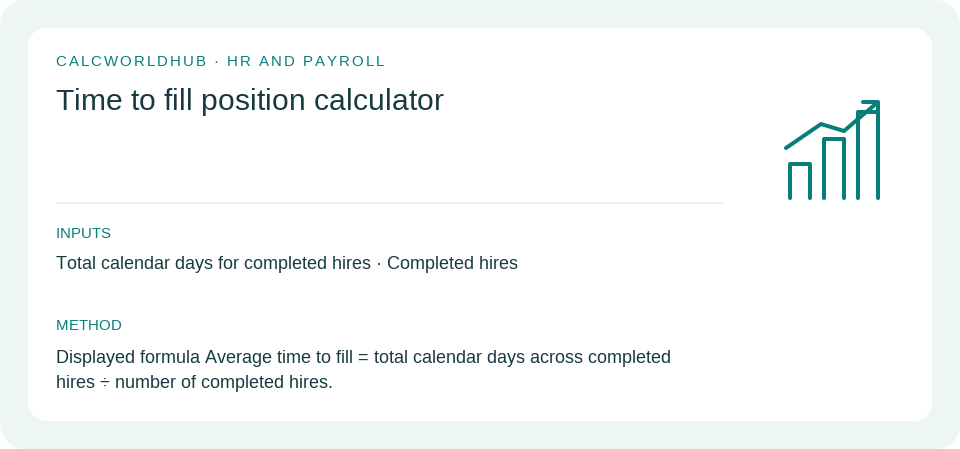
Average time to fill = total calendar days across completed hires ÷ number of completed hires.
Worked example
If 12 completed hires took a combined 240 calendar days from requisition opening to accepted offer, average time to fill is 240 ÷ 12 = 20 days.
Assumptions and limits
This simple mean can be affected by outliers and does not include roles still open. Time-to-fill and time-to-hire may use different start events, so document the convention.
Frequently asked questions
What is the difference between time to fill and time to hire?
Time to fill often starts when a requisition opens; time to hire may start when a candidate enters the funnel. Define your organization’s events.
Should open roles be included?
This mean uses completed hires only; open roles are censored durations and need separate treatment.
Is the mean affected by outliers?
Yes. A few unusually long searches can raise the average; pair it with a median when useful.
How do I use the Time to fill position calculator?
Enter Total calendar days for completed hires, Completed hires. Match the units shown beside each field and review the result together with the assumptions below.
What is a worked example of Time to fill position?
If 12 completed hires took a combined 240 calendar days from requisition opening to accepted offer, average time to fill is 240 ÷ 12 = 20 days.
Read our calculation methodology.