Transformer output power estimate calculator
Estimate secondary power after an efficiency allowance. Enter your values below for a free estimate, with no account required.
inputs.
Calculator
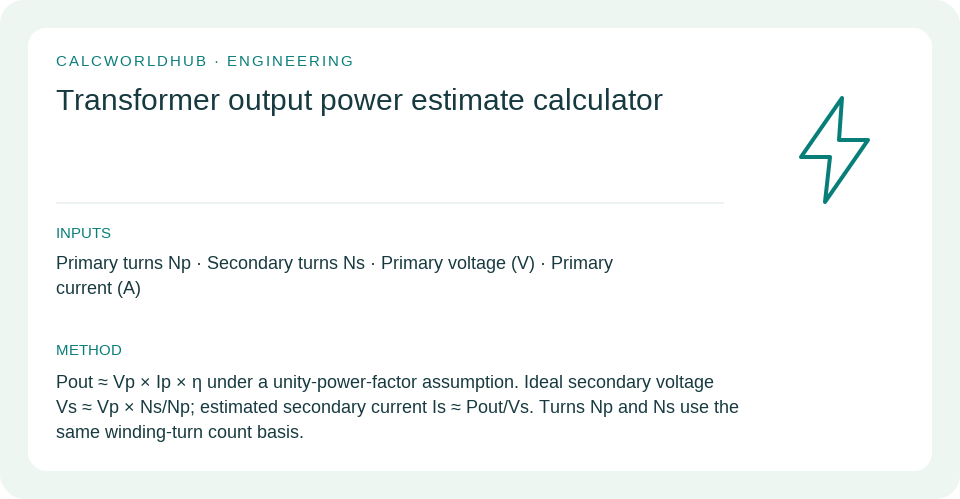
How to use the Transformer output power estimate calculator
Estimate secondary power after an efficiency allowance. Enter your values below for a free estimate, with no account required.
What this calculator measures
Estimate transformer output power from primary voltage, primary current, and an entered efficiency; also calculate the ideal turns-ratio secondary voltage and corresponding current.
Inputs and units
The required fields are Primary turns Np, Secondary turns Ns, Primary voltage (V), Primary current (A), Transformer efficiency (0–1). Each value should describe the same object, sample, transaction, or time period wherever the formula compares them.
- Primary turns Np: Enter the value that matches the field label and its displayed unit.
- Secondary turns Ns: Enter the value that matches the field label and its displayed unit.
- Primary voltage (V): Enter the value that matches the field label and its displayed unit.
- Primary current (A): Enter the value that matches the field label and its displayed unit.
- Transformer efficiency (0–1): Enter the value that matches the field label and its displayed unit.
Formula and method
Pout ≈ Vp × Ip × η under a unity-power-factor assumption. Ideal secondary voltage Vs ≈ Vp × Ns/Np; estimated secondary current Is ≈ Pout/Vs. Turns Np and Ns use the same winding-turn count basis.
Worked example
With 230 V and 2 A primary input at 94% efficiency, estimated output is 230 × 2 × 0.94 = 432.4 W. For 500 primary turns and 100 secondary turns, ideal secondary voltage is 46 V and estimated current is 432.4/46 = 9.4 A.
How to use the calculator
- Read the field labels and select values from the same source and measurement basis.
- Enter Primary turns Np and the other required values. Use the units printed on the page and convert mixed units first.
- Review the displayed method, then compare the result with the question you are trying to answer.
- Change one input at a time to see which assumption has the greatest effect on the result.
Interpreting the result
The first output is an approximate real output power. Secondary voltage follows the turns ratio, while current is inferred from power divided by that ideal voltage; actual loaded voltage and current depend on transformer design and load.
Assumptions and limits
The power estimate treats Vp × Ip as real input power, equivalent to unity power factor for an AC load or a DC input model. Actual AC input power requires power factor; secondary voltage is ideal and ignores regulation and winding drops. This is not a protection or equipment-sizing result.
This is an idealized calculation based on the entered assumptions. Verify boundary conditions, material properties, safety factors, and applicable standards before using it in a design.
Frequently asked questions
What information do I need?
Enter positive primary and secondary turn counts, primary voltage, primary current, and efficiency as a fraction from 0 to 1. Turns are ratios, so both counts must use the same winding convention.
How should I interpret the result?
The power output applies the entered efficiency to the primary volt-ampere product with unity power factor assumed. The secondary voltage is the ideal turns-ratio estimate; current is estimated from output power divided by that voltage.
Is the Transformer output power estimate calculator free to use?
Yes. This calculator is free and works in your browser without an account.
How do I use the Transformer output power estimate calculator?
Enter Primary turns Np, Secondary turns Ns, Primary voltage (V), Primary current (A), then complete the remaining labeled fields. Match the units shown beside each field and review the result together with the assumptions below.
What is a worked example of Transformer output power estimate?
With 230 V and 2 A primary input at 94% efficiency, estimated output is 230 × 2 × 0.94 = 432.4 W. For 500 primary turns and 100 secondary turns, ideal secondary voltage is 46 V and estimated current is 432.4/46 = 9.4 A.
Read the calculation methodology and privacy policy.
Good calculators show their work.
CalcWorldHub is built around clear inputs and visible assumptions. Results are estimates for planning; check official sources or your provider’s terms when exact figures matter.