How to use this calculator
Compare nominal and worst-case series/parallel resistance for two independent tolerance-bounded resistors.
- Enter First resistance (Ω), Second resistance (Ω), Each resistor tolerance (%). Match the units shown beside each field and review the result together with the assumptions below.
- Read the worked example below to check the expected input format and result.
- Compare another scenario by changing one input at a time. Use Reset to return to the starting values.
Two resistor tolerance network explained
For two positive resistors sharing the entered tolerance, series and parallel network extrema occur at the corresponding tolerance corners. These are worst-case bounds, not probability intervals; use the same resistance unit and consider correlated tolerances or temperature behavior separately.
Inputs, symbols, and units
a— First resistance (Ω)- First resistance (Ω).
b— Second resistance (Ω)- Second resistance (Ω).
t— Each resistor tolerance (%)- Each resistor tolerance (%).
Formula and method
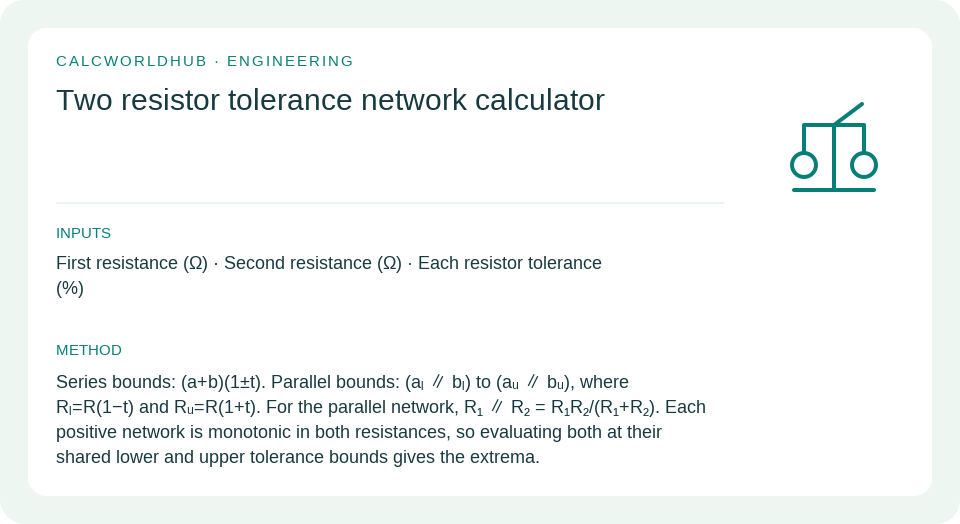
Series bounds: (a+b)(1±t). Parallel bounds: (aₗ ∥ bₗ) to (aᵤ ∥ bᵤ), where Rₗ=R(1−t) and Rᵤ=R(1+t).
For the parallel network, R₁ ∥ R₂ = R₁R₂/(R₁+R₂). Each positive network is monotonic in both resistances, so evaluating both at their shared lower and upper tolerance bounds gives the extrema.
A worked scenario
First resistance (Ω) = 100; Second resistance (Ω) = 220; Each resistor tolerance (%) = 5.
- Maximum series resistance: 336 Ω
- Minimum series resistance: 304 Ω
- Minimum parallel resistance: 65.3125 Ω
- Maximum parallel resistance: 72.1875 Ω
This scenario uses the stated units and assumptions. Displayed values are rounded only after calculation.
Assumptions and edge cases
Bounds are worst-case, not probability intervals; both resistors share the entered percentage tolerance.
Frequently asked questions
Is worst-case statistically likely?
Not necessarily.
Does correlation change the bounds?
The corner combinations still bound positive monotonic networks.
Are temperature coefficients included?
No.
How do I use the Two resistor tolerance network calculator?
Enter First resistance (Ω), Second resistance (Ω), Each resistor tolerance (%). Match the units shown beside each field and review the result together with the assumptions below.
What is a worked example of Two resistor tolerance network?
First resistance (Ω) = 100; Second resistance (Ω) = 220; Each resistor tolerance (%) = 5. Maximum series resistance: 336 Ω Minimum series resistance: 304 Ω Minimum parallel resistance: 65.3125 Ω Maximum parallel resistance: 72.1875 Ω This scenario uses the stated units and assumptions. Displayed values are rounded only after calculation.
Read our calculation methodology.