Two-state Markov n-step probability calculator
Propagate the probability of state 1 through n steps of a fixed two-state Markov chain.
How to use this calculator
Propagate the probability of state 1 through n steps of a fixed two-state Markov chain.
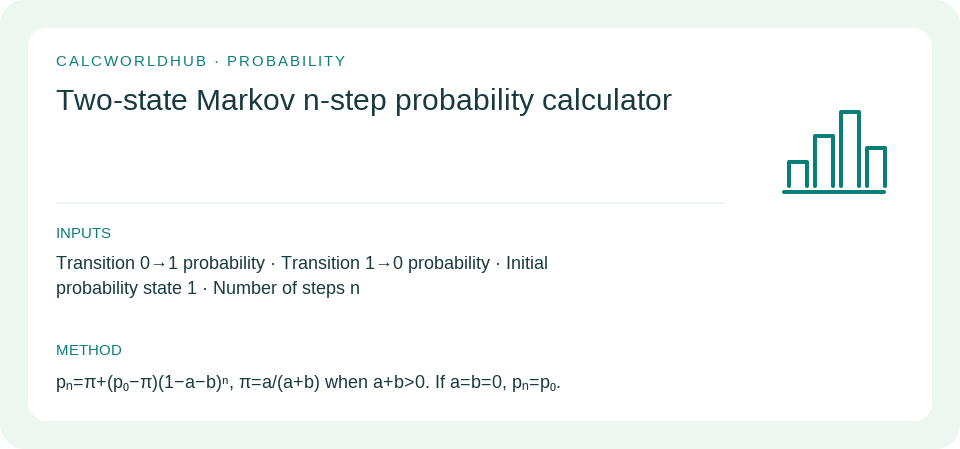
- Enter Transition 0→1 probability, Transition 1→0 probability, Initial probability state 1, Number of steps n. Match the units shown beside each field and review the result together with the assumptions below.
- Read the worked example below to check the expected input format and result.
- Compare another scenario by changing one input at a time. Use Reset to return to the starting values.
How the Two-state Markov n-step probability calculator works
Propagate the probability of state 1 through n steps of a fixed two-state Markov chain.
Inputs and units
- Transition 0→1 probability: a is the probability of transition 0→1 in each step.
- Transition 1→0 probability: b is the probability of transition 1→0 in each step.
- Initial probability state 1: p₀ is the initial probability of being in state 1.
- Number of steps n: n is a whole nonnegative number of transitions.
Formula and method
pₙ=π+(p₀−π)(1−a−b)ⁿ, π=a/(a+b) when a+b>0. If a=b=0, pₙ=p₀.
Worked example
With a=0.2, b=0.1, p₀=0, and n=1, p₁=0.2.
Interpreting the result
The probability is a distribution value after exactly n transitions. For a=b=0 the chain never changes; every initial distribution is stationary, so there is no unique stationary probability.
Assumptions and limits
Transitions are time-homogeneous and probabilities lie in [0,1]. A two-state chain can be periodic; a stationary distribution need not describe the n-step value for small n.
Sources and method
- Defines transition matrices and stationary-distribution concepts used to interpret the two-state chain. Carnegie Mellon University: Markov Chains—Introduction
Frequently asked questions
What if a=b=0?
The transition matrix is the identity, so pₙ=p₀ and every distribution is stationary; there is no unique stationary probability.
Does every two-state chain converge to its stationary distribution?
No. A periodic chain can oscillate even though a stationary distribution exists.
How do I use the Two-state Markov n-step probability calculator?
Enter Transition 0→1 probability, Transition 1→0 probability, Initial probability state 1, Number of steps n. Match the units shown beside each field and review the result together with the assumptions below.
What is a worked example of Two-state Markov n-step probability?
With a=0.2, b=0.1, p₀=0, and n=1, p₁=0.2.
What does the Two-state Markov n-step probability calculator calculate?
Propagate the probability of state 1 through n steps of a fixed two-state Markov chain.
See the calculation methodology.